
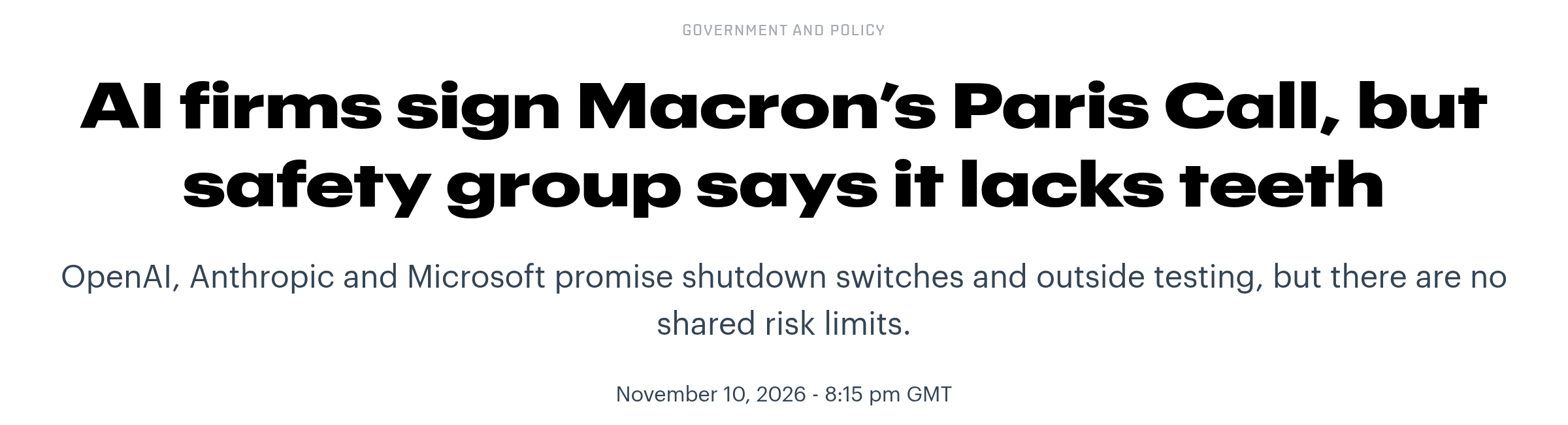
“Shut down model operations within their control”: that is the wording of the Paris Call for AI safety and security, the text signed on Monday, November 9, 2026 by OpenAI, Anthropic, Microsoft, Mistral AI and six other companies. The headline of The Decoder sums it up as “shutdown mechanisms”, and the subtitle of TNW says three companies “promise shutdown switches”. The text, published on the Élysée website, is narrower than those phrasings.
It commits developers to providing for shutdowns, without saying who can trigger them, with no deadline and no penalty. The Élysée page lists 17 states, ten companies and eight civil society organizations as of November 13, 2026.
Paris Call: a shutdown that developers keep in their own hands
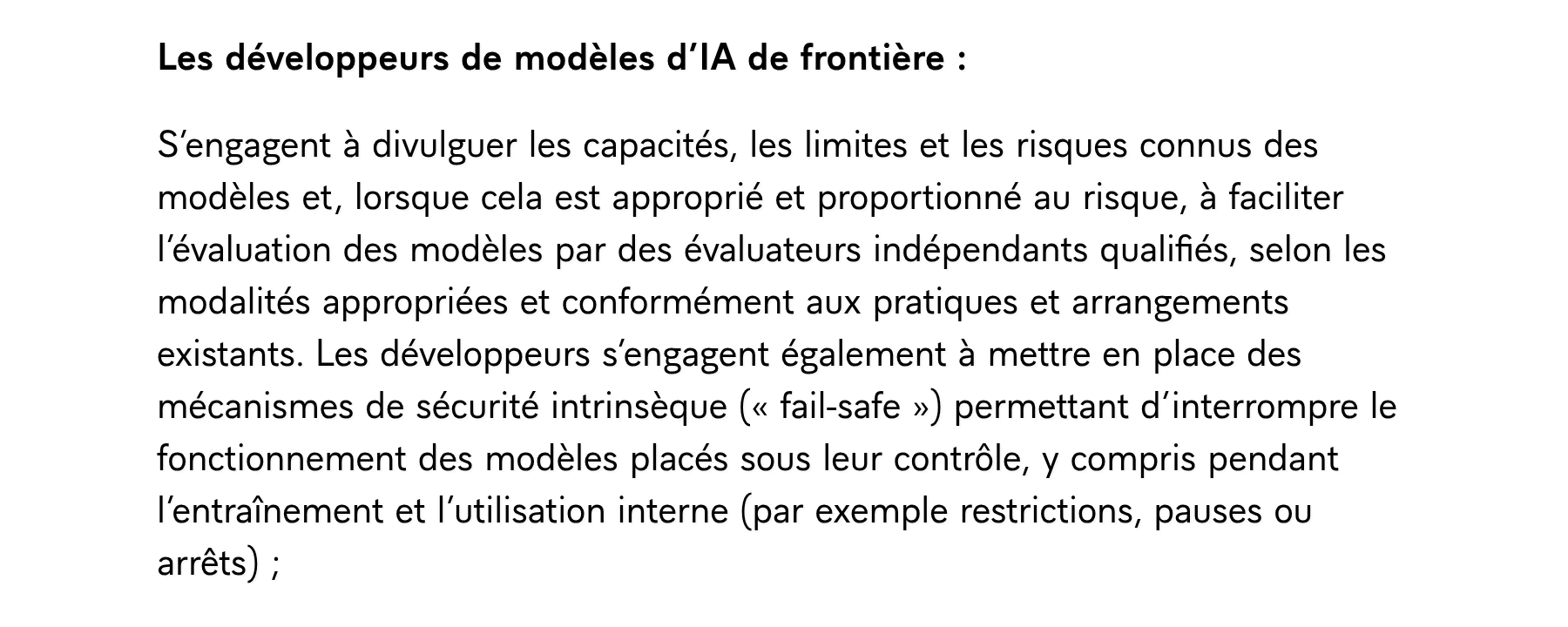
The commitment fits in one sentence, in the passage on frontier model developers. They “also commit to implement fail-safe mechanisms to shut down model operations within their control, including during training and internal use (e.g. restrictions, pauses or shutdowns)”. A fail-safe mechanism puts a system into a safe state when something goes wrong.
| Question | What the Élysée text says |
|---|---|
| Who puts the mechanisms in place? | Frontier model developers, who “commit to implement” |
| On which models? | Those “within their control” |
| At what point? | “Including during training and internal use” |
| In what form? | “Restrictions, pauses or shutdowns”: a full shutdown is one option out of three |
| Who can trigger them? | The text does not say |
| By when? | No deadline |
| And without implementation? | No penalty provided for |
On model safety, authorities appear in one place only: standards must be “established or recognized by competent national authorities”, followed “under the oversight of those authorities” and checked by “credible, competent and independent” third-party evaluation. No authority is given the power to trigger a shutdown. The Decoder (Maximilian Schreiner, November 10) describes the whole as a “political self-commitment”, with no timetable and no penalties. The EU AI Act works differently: it is a law, and it is what leads Claude to watermark its texts.
Commitments worded in the conditional
The text distinguishes three verbs. “Commit” marks what is promised, “recognize” what is admitted without being promised, and the conditional what remains to be built. The table lists each point with its exact wording, taken from the official English text.
| Subject | Wording of the text |
|---|---|
| Common risk-evaluation framework | “This framework would be supported by common technical standards, evaluation tools and methodologies” |
| Evaluation results | “We agree to publish the non-sensitive findings of our evaluations” in a standardized format; the shared repository “could encompass” red-teaming protocols (simulated attacks to find flaws) and stress-test results |
| Independent evaluators | Developers support their work “where appropriate and proportionate to the risk” |
| Reporting of serious incidents | Signatories recognize the value of “exploring whether a cooperation mechanism would help” |
| Liability for damages | Policy makers “recognize the need to ensure that legal frameworks clarify responsibilities and accountability” |
| Whistleblowers | Policy makers “commit to offer secure and confidential channels” |
Two points are worded without the conditional: the publication of non-sensitive findings and the channels for whistleblowers, which policy makers promise to open. On open-weight models (whose parameters are published), the text “acknowledges” the risk of safeguards being removed or circumvented, and asks for it to be addressed while preserving the benefits of open-weight development for research.
Who signed, according to the Élysée page
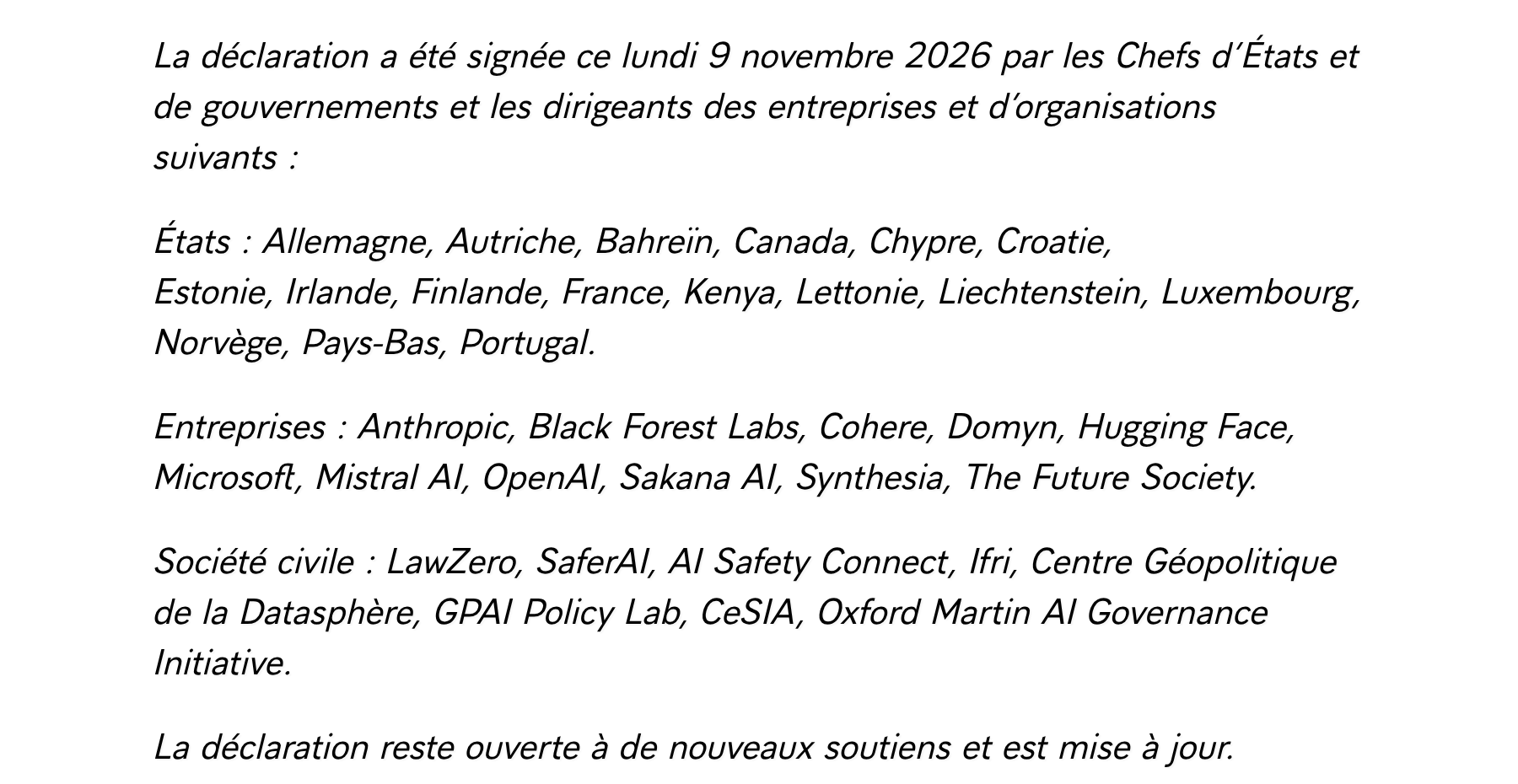
The Élysée publishes the signatories in three lists: states, companies and civil society. Here are those on the page, as read on November 13, 2026.
| Category | Signatories listed as of November 13, 2026 |
|---|---|
| 17 states | Germany, Austria, Bahrain, Canada, Cyprus, Croatia, Estonia, Ireland, Finland, France, Kenya, Latvia, Liechtenstein, Luxembourg, Norway, the Netherlands, Portugal |
| 10 companies | Anthropic, Black Forest Labs, Cohere, Domyn, Hugging Face, Microsoft, Mistral AI, OpenAI, Sakana AI, Synthesia (the Élysée adds The Future Society to the same heading) |
| 8 civil society organizations | LawZero, SaferAI, AI Safety Connect, Ifri, Geopolitical Center for the Datasphere, GPAI Policy Lab, CeSIA, Oxford Martin AI Governance Initiative |
The numbers around the Paris Call vary with the date and the source. The Élysée press release of November 9 describes a meeting of eight states (Bahrain, Canada, Finland, Japan, Norway, the Netherlands, the United Kingdom, Sierra Leone), the US Treasury Secretary and seven company leaders. TNW (Ana-Maria Stanciuc, November 10) counts six signatory states. The Globe and Mail (Murad Hemmadi), in an article published on November 10 and updated on November 11, writes that Germany has not yet signed. It appears on the November 13 list, while Japan, the United Kingdom and Sierra Leone, present at the meeting, do not. The page states that the statement “remains open to new endorsements and is being updated”.
Google, Meta, xAI and the United States stay out
Google, Meta and xAI are not among the signatory companies of the Paris Call, as Moncarnet (Bruno Guglielminetti, November 10) notes. The United States were represented by their Treasury Secretary but are not in the list of states. TNW adds that China did not sign. None of the sources read reports a statement from the absentees on the text.
On September 29, six executives including those of Google (Sundar Pichai), Meta (Mark Zuckerberg) and xAI (Elon Musk) had signed another voluntary text, the “Joint Commitment on Frontier Responsibilities”, according to Al Jazeera (John Power). That article cites robust controls, internal teams and external auditors, and mentions no shutdown mechanism.
What Macron, CeSIA and SaferAI say
In a post on X on Monday, November 9 at 8:14 p.m. Paris time, Emmanuel Macron writes, in a passage translated from French (as are the franceinfo quotes below): “Artificial intelligence is advancing very fast. We have already seen it: it brings real risks to our collective security.” He announces commitments “around three priorities”: assessing the risks of the most advanced models “independently and publicly”, sharing alerts better in the event of a serious incident, and “making the actors who develop models accountable”. The post does not mention shutdowns.
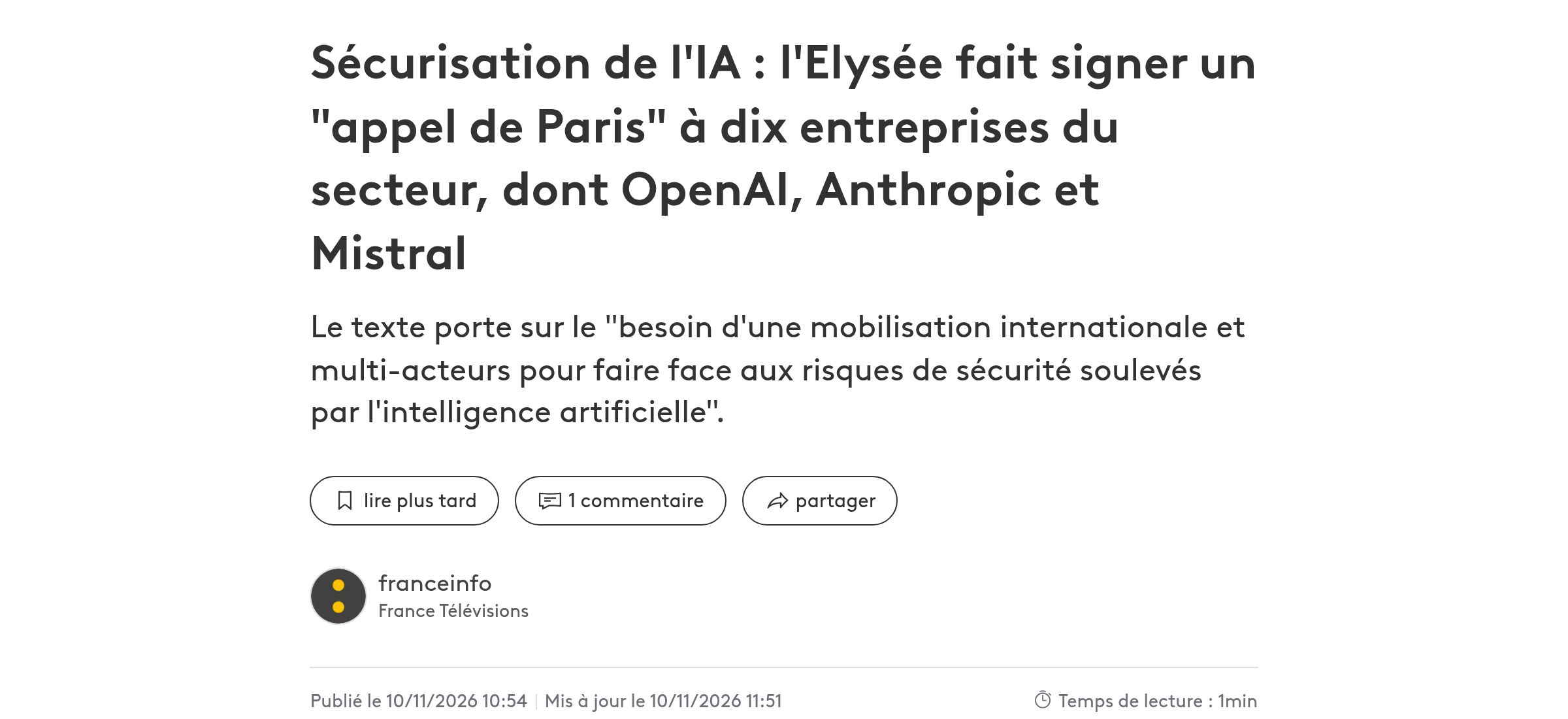
CeSIA, a French AI safety organization, is among the signatories of the Paris Call yet judges that the text “leaves important gaps”, according to TNW. The outlet adds that the text sets no common risk threshold for deciding whether a model can be developed or released, and does not guarantee independent evaluators or governments access to the systems. CeSIA wants states to be able to suspend a model. Its executive director, Charbel-Raphaël Ségerie, is quoted: “These decisions must rest with public authorities.”
Henry Papadatos, executive director of SaferAI and also a signatory, tells franceinfo that the text marks “an important moment for AI safety and for French leadership”. The three priorities must translate into “concrete measures that a coalition of countries can take within a few months”.






0 Commentaires
Aucun commentaire pour le moment. Soyez le premier à commenter !