

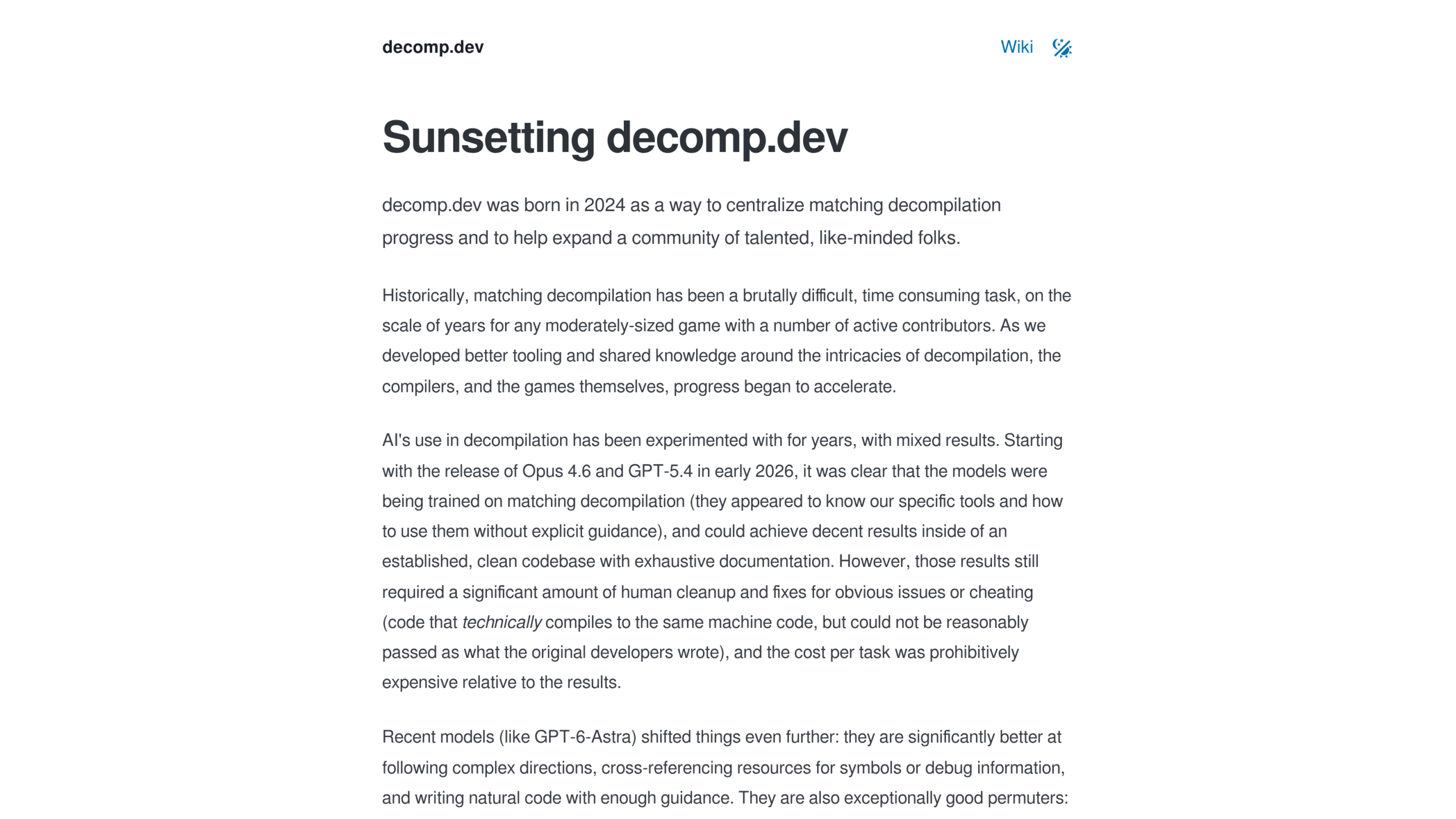
For two years, a progress bar made hundreds of volunteers want to rebuild the code of their favorite games, function by function. The site that listed them all in one place, decomp.dev, no longer accepts new projects and has closed its public index. Its creator, who signs as « encounter », blames AI decompilation: models that can finish in a few days what used to take years.
What closes, and what stays online
The post is titled « Sunsetting decomp.dev ». It separates two things. The main index and the addition of new projects are disabled. The site does keep tracking existing projects, serving their individual pages and their historical data.
The site’s code is not open. Encounter states that nobody should fork it or host a copy, and that all rights are reserved. The site was born in 2024 to gather the progress of projects and bring a community together, with a game-like logic: the further the bar moved, the more motivated contributors became.
« Matching » decompilation in two sentences
A video game ships as a binary, a block of machine code that a human cannot read. « Matching » decompilation means rewriting source code that, once recompiled, gives back exactly the same binary, byte for byte. It is painstaking work: each function must match before you move on to the next.
The appeal goes beyond curiosity. Readable source code lets people understand how a game works, preserve it and, later, recompile it for another platform. Native PC ports of old titles often start there.
What AI decompilation changed
Encounter describes progress in two steps. In early 2026, the Opus 4.6 and GPT-5.4 models gave decent results on clean, well-documented codebases, but needed heavy human cleanup and cost a lot. Then came GPT-6-Astra, which he finds far better at following complex instructions, cross-checking symbols, working for a long time and permuting code until it finds the exact match. This model is also at the heart of another recent debate about the word AGI, and yet its free version got it wrong twice in our test. OpenAI has since dropped Astra 6.1 in favor of Sol, five times cheaper: cost, which still held back these uses in early 2026, keeps falling.
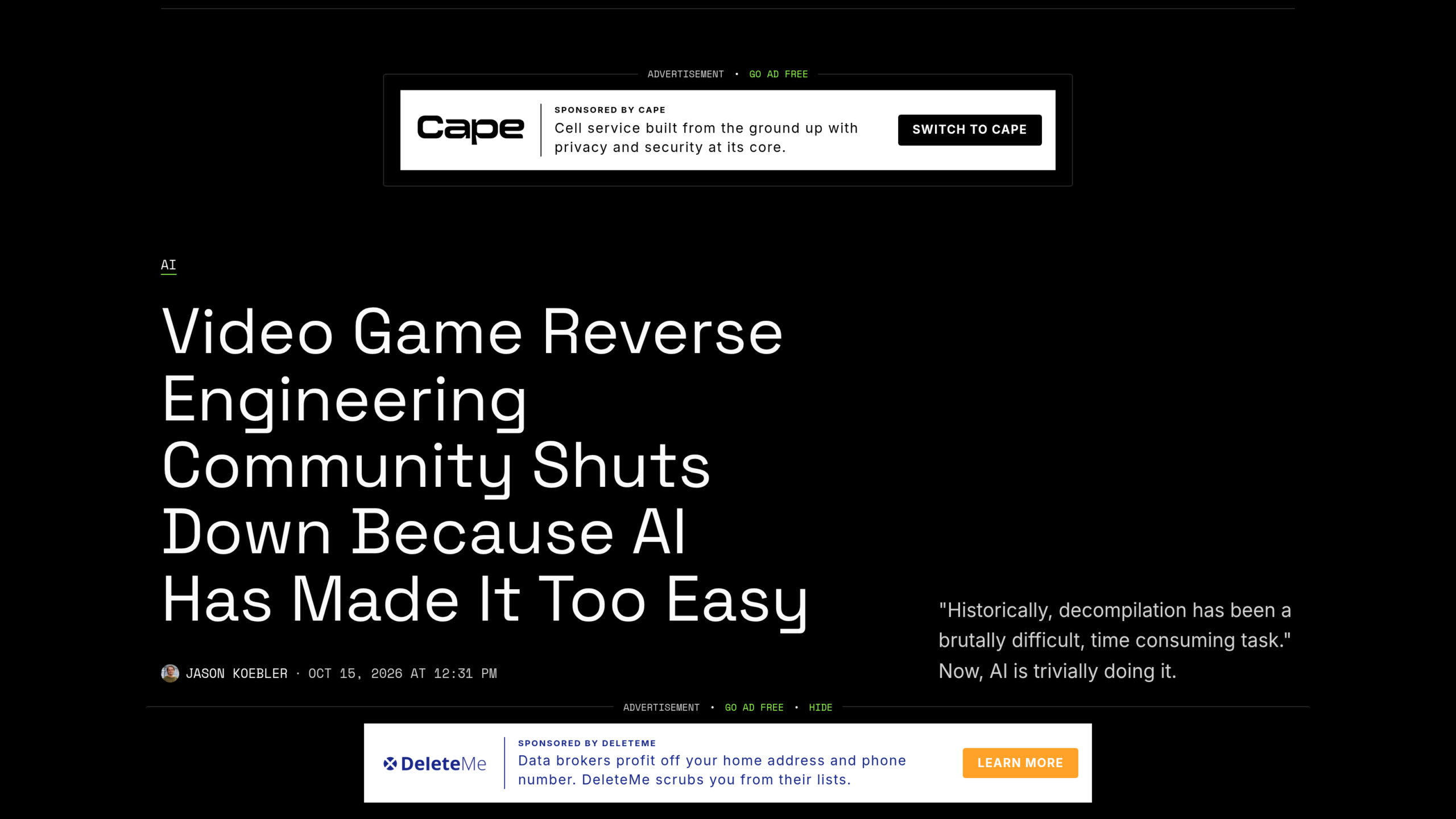
The site 404 Media picks up on this. Jason Koebler quotes encounter: matching decompilation has historically been « a brutally difficult, time consuming task », on the scale of years for a moderately sized game with several active contributors. With the right guidance, human input and code reviews, he writes, AI can expedite the decompilation process « in a significant way ». The outlet adds that it is becoming impossible to tell human-led projects from AI-driven ones.
Three abuses the post blames on AI use
Encounter lists the behaviors that, in his view, broke the community spirit. First: forking existing projects to « finish » them with an AI, often with no real contribution. Second: racing to release a port, relying on reconstructions you did not help build. Third: confusing decompilation with a port.
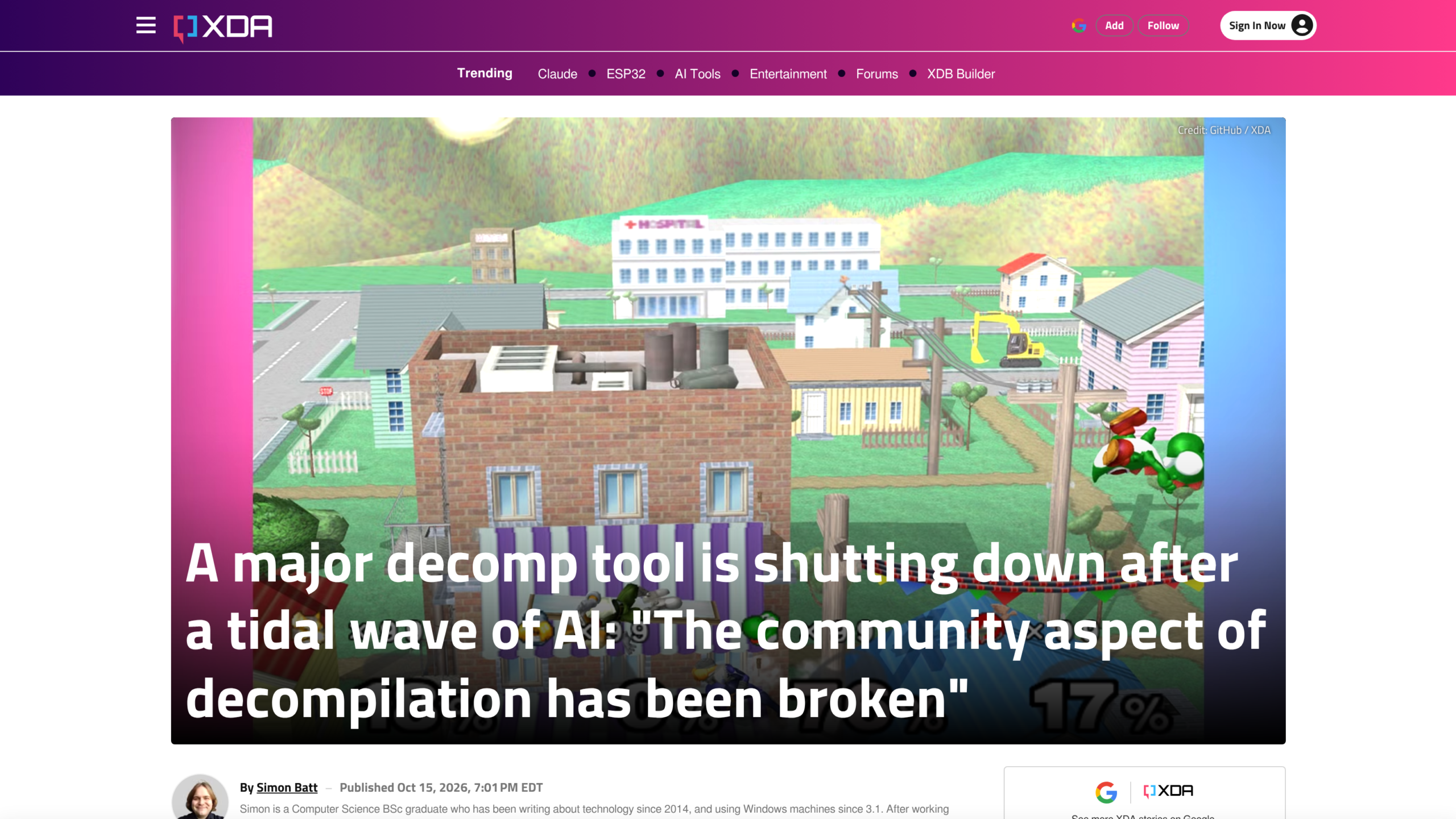
These moves have a human cost. XDA sums up the mechanics: someone takes the current state of a volunteer-run project, publishes it half-finished and collects the credit. It also reminds readers that some enthusiasts decompile for the pleasure of understanding code, with no port in mind.
A nuanced post, and sources that do not say quite the same thing
This is not an indictment of the models. Encounter writes that he has long held the opinion that AI is not the issue by itself. He admits that a project guided, reviewed and supervised by humans can benefit from it. He also explains why he did not ban AI-assisted projects: « slop » (sloppy content produced in bulk) is hard to define and to moderate, and a lone volunteer cannot enforce a quality standard across hundreds of projects. Finally, he thanks everyone who contributed to the projects, the communities and the tools, and says the people and their passion made the adventure rewarding.
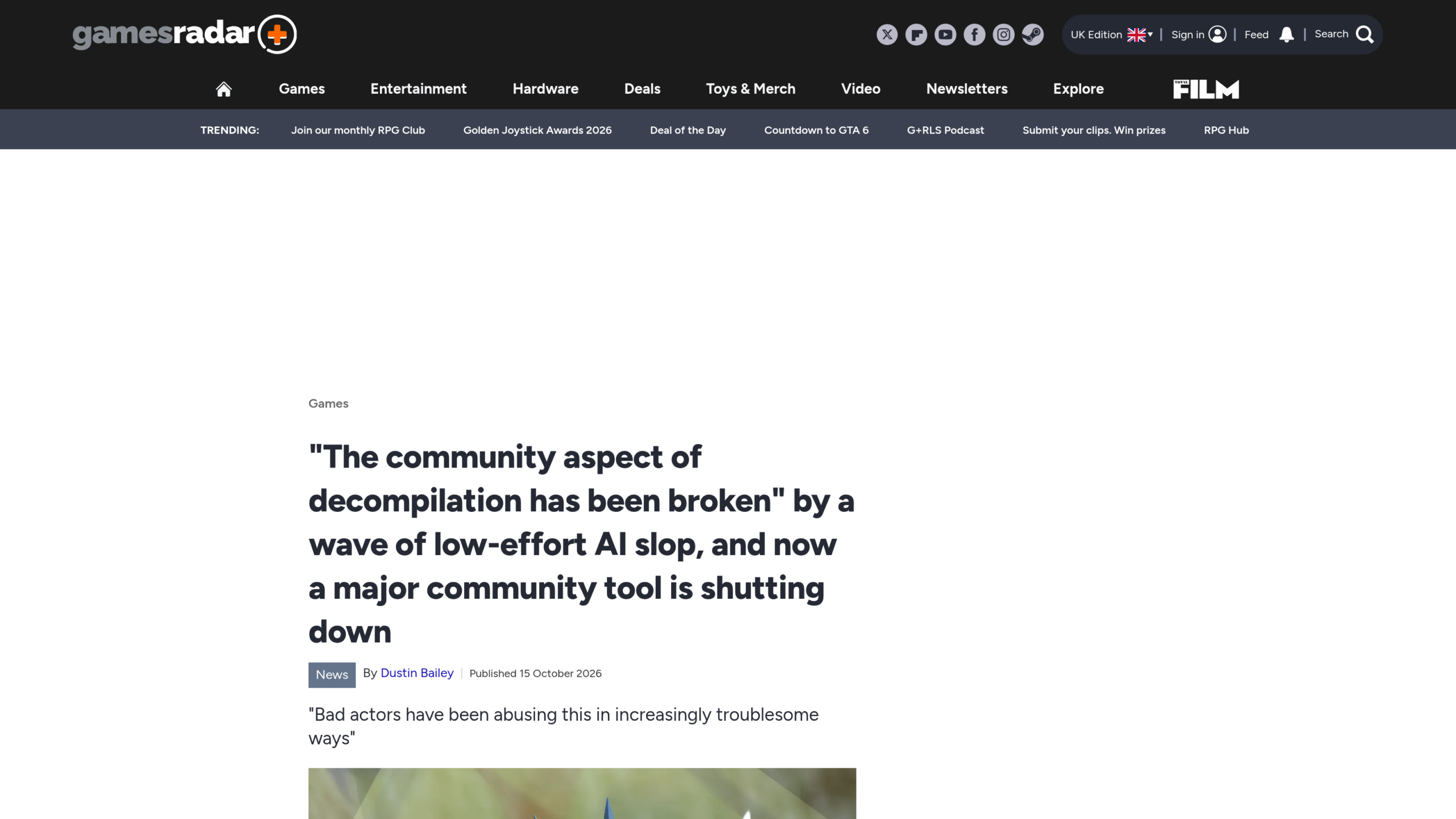
The media, for their part, talk more readily about a shutdown. The headline of GamesRadar announces that a major tool is closing and borrows the phrase « The community aspect of decompilation has been broken ». Its subtitle quotes another line from the post: « Bad actors have been abusing this in increasingly troublesome ways ». XDA writes that the site has closed, without saying what stays online. Only the original post settles it: the index and new projects are cut, while tracking of ongoing projects continues.
For encounter, AI decompilation is a problem because of what humans do with these models, not because of their capability. Ongoing projects keep their page. The race, though, will now be run without a scoreboard.









0 Commentaires
Aucun commentaire pour le moment. Soyez le premier à commenter !