

On Monday, October 26, 2026, Meta launched two stock offerings worth about 35 billion dollars. The Meta 35 billion plan is only the first tranche: according to Reuters, republished by The Globe and Mail, the group plans to raise up to 95 billion dollars in all, its largest equity raise. The money is meant to pay for data centres and chips for artificial intelligence.
Meta 35 billion: what the two offerings contain
The detail comes from The Next Web (Cristian Dina, October 26) and from the documents filed the same day with the SEC (the US stock-market regulator). Two financial products are being sold:
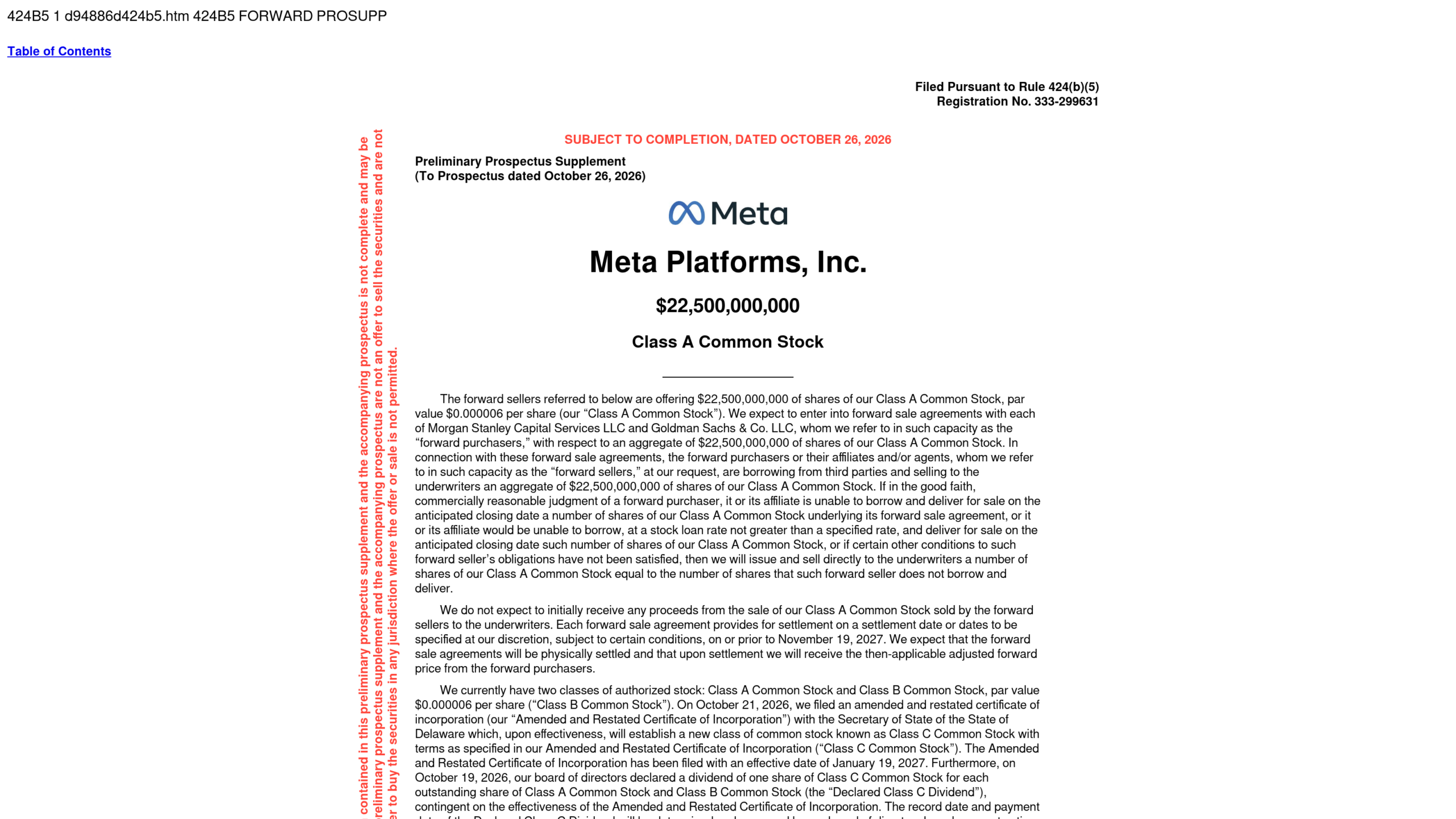
- 22.5 billion dollars of Class A common stock, sold through « forward sale » contracts: the banks borrow shares and place them now, but Meta only collects the money at settlement, by November 19, 2027 at the latest.
- About 12.5 billion dollars of mandatory convertible preferred stock: it pays a dividend, then turns into common stock around August 15, 2029. The rate will be set when the shares are priced.
Morgan Stanley and Goldman Sachs run both operations. Meta says the funds will go to « general corporate purposes », and since the price of the common shares is only collected at settlement, the group does not expect to receive cash right away on that part.
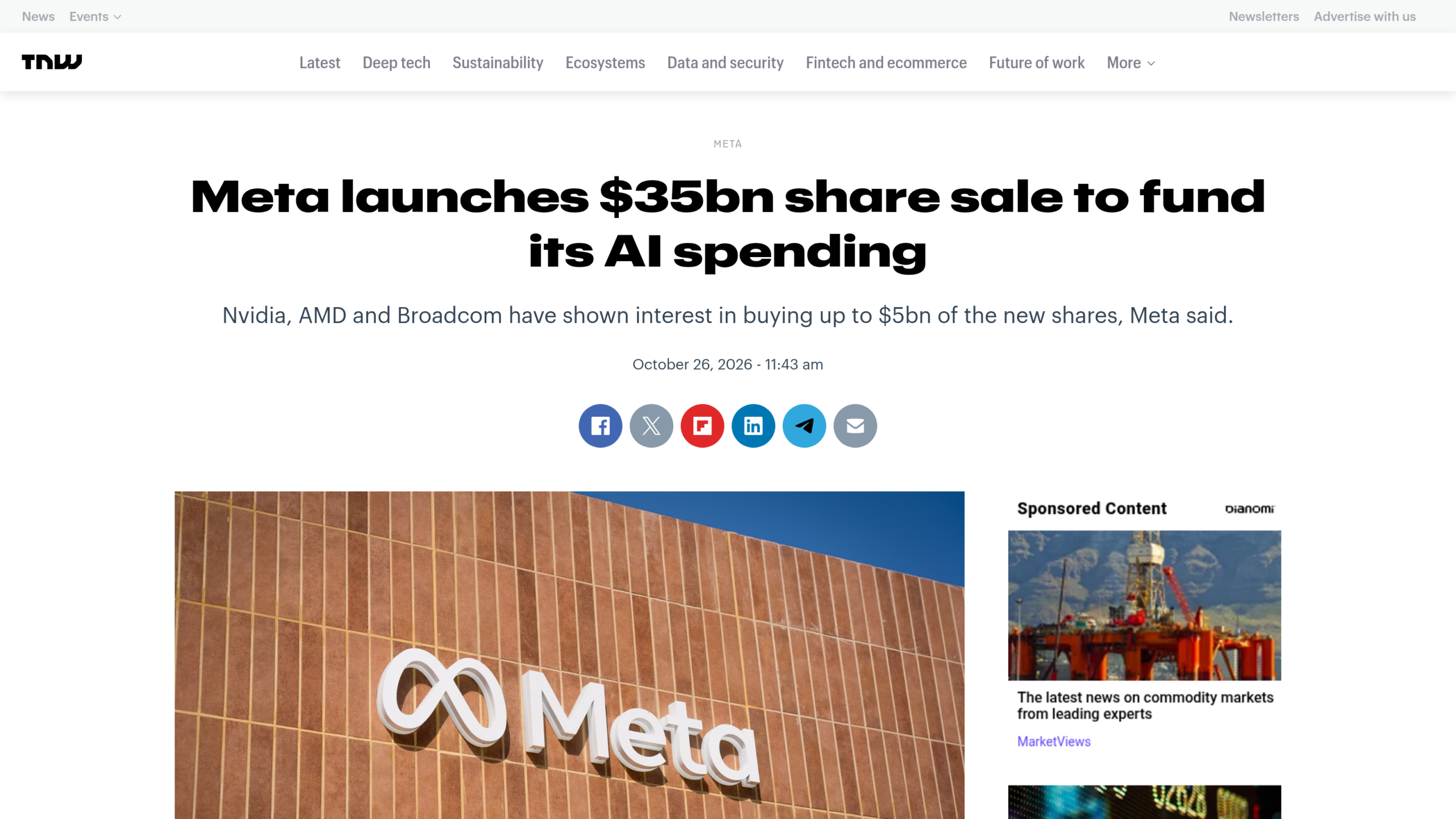
The third part is still to come. Meta wants to sell up to 60 billion dollars of non-voting Class C shares through an « at-the-market » programme (sales on the open market as needed). Reuters specifies that the programme will start after these new shares begin trading, expected in the first quarter of 2027, and that neither the timing nor the terms are final. Today’s 35 billion and those future 60 billion make the announced 95 billion. Reuters also points out that Class C amounts to splitting the stock in two, while leaving Mark Zuckerberg in control of the company.
Nvidia, AMD and Broadcom on the list of possible buyers
Meta said that Nvidia, AMD and Broadcom, three of its chip suppliers, have shown a combined interest of up to 5 billion dollars in Class A shares. That interest binds no one: nothing is signed.
Reuters draws a concern from it: these possible purchases feed the fear of an « increasingly circular flow of capital », since chip sellers would help finance one of their biggest customers. William Blair analysts, quoted by the agency, write: « We expect investors to continue to question the financing and potential for future capital raises. » For a gamer, the name Nvidia is familiar: it makes the GeForce graphics cards, whose prices we follow in our article on the RTX 5090 and the denial of a production halt.
Why Meta turns to shareholders
The figures reported by Reuters explain that need. Meta has committed to spend about 825 billion dollars in the future, mostly on data centres, AI infrastructure and rented computing power. Last week, the group raised the low end of its capital-spending range for the year, now between 135 and 145 billion dollars. In the third quarter, its free cash flow was negative by 2.12 billion dollars, a first in more than ten years, against +10.63 billion a year earlier.
On September 30, Meta held 82.45 billion dollars in cash and investments, against 80.92 billion in long-term debt. The group is not short of money: according to Investing.com, quoted by The Next Web, it generated 97 billion dollars of operating cash in the first nine months. But the bill is growing faster. Meta is not alone: Reuters notes that Alphabet raised its equity offerings earlier this year to 84.75 billion dollars.
On the stock market, the reaction was jittery. According to The Next Web, the share lost up to 4% on Monday before climbing back to around +1%. Reuters reported a drop of about 1.4% in the morning. This article does not say whether to buy or sell anything.
The link with memory and graphics cards
No Meta document says what share of the 35 billion will go to memory or GPUs (graphics processors, also used to train AIs): the stated use is general. The link with gamers goes through demand. Michael Dell, head of Dell Technologies, explained that the memory shortage could last four years and worsen in 2027, as we detailed in our article on Michael Dell’s warning. TrendForce, quoted in that piece, forecasts that PC DRAM supply could decline in 2027, because factory capacity is shifting to servers.
The data centres these 35 billion will fund are part of that demand, along with those of Alphabet and the other AI giants. The more fresh money flows to these servers, the less reason there is for the tension on chips and memory to ease quickly. This is a reading of overall demand, not a measure of Meta’s purchases, which nobody has published.
The timeline comes down to two dates: the banks have until November 19, 2027 to settle the Class A shares, and the 60 billion dollar programme cannot start before the Class C shares arrive, expected in the first quarter of 2027.






0 Commentaires
Aucun commentaire pour le moment. Soyez le premier à commenter !