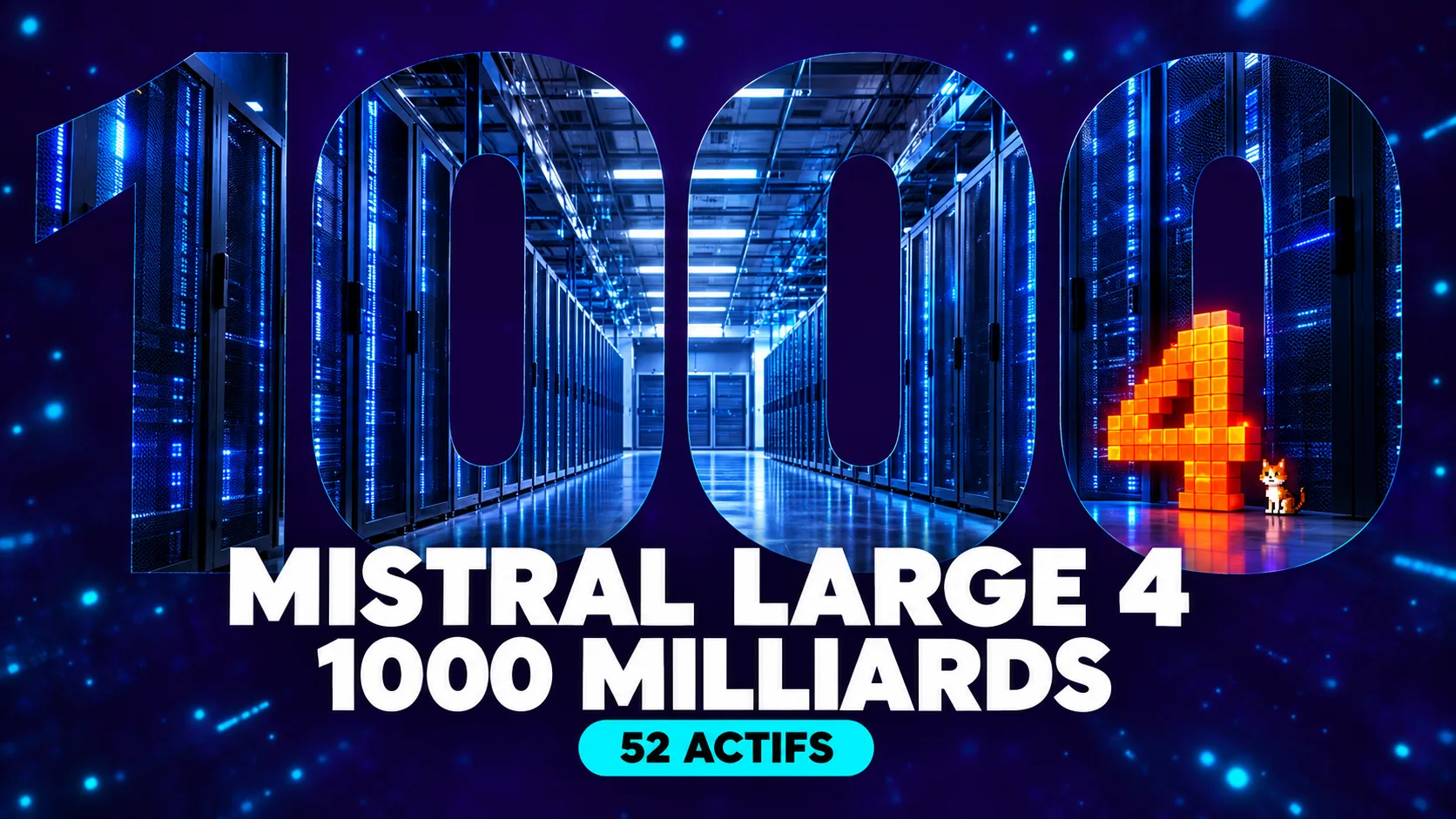
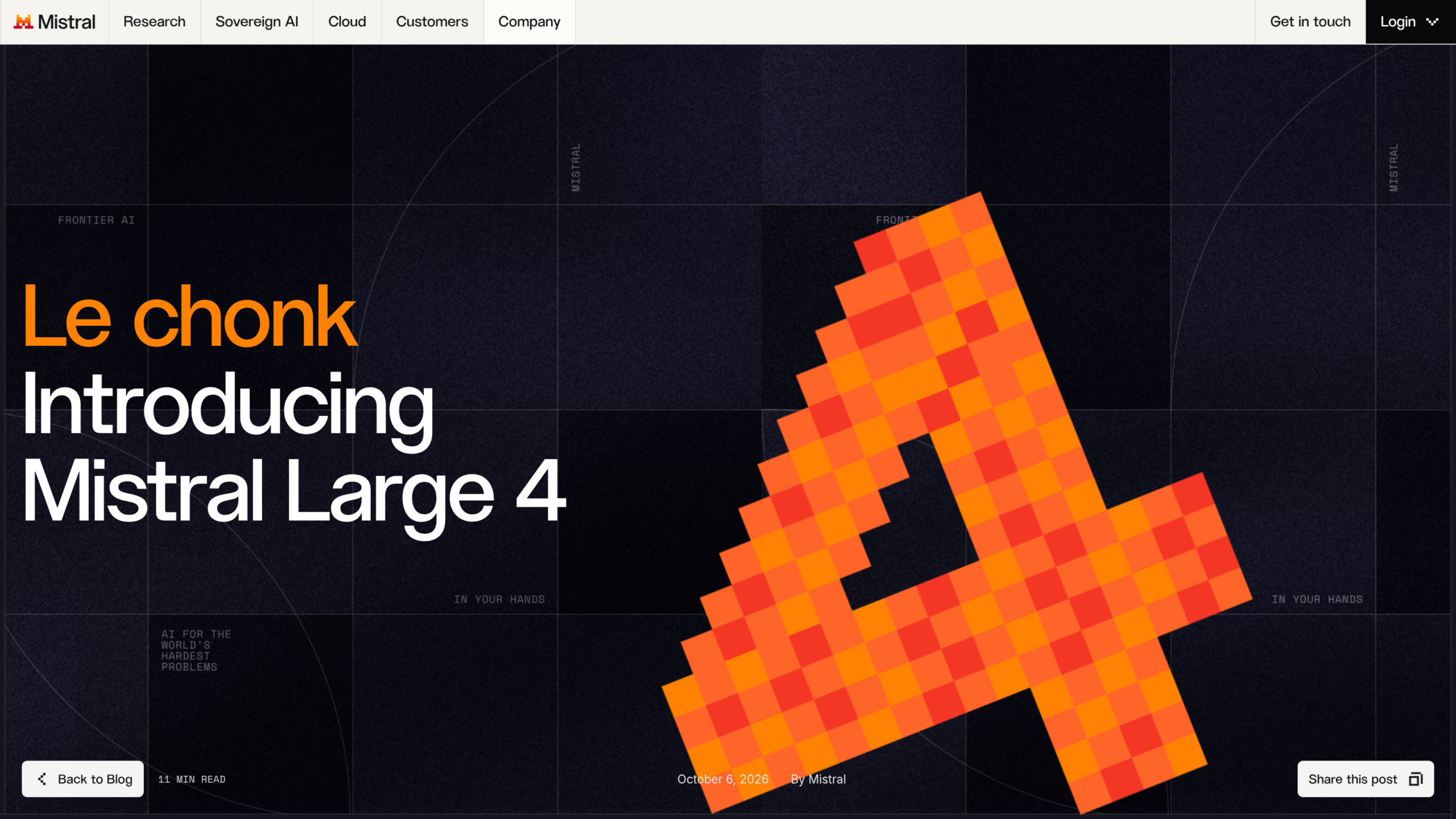
1.05 trillion parameters in total, 52 billion working on every word, a million tokens of context and a nickname borrowed from English slang: “the chonk” means something big and sturdy. On October 6, 2026, Mistral opened access to Mistral Large 4 as a public preview, with weights the French company promises to release before the end of the month.
The performance figures below are the ones Mistral claims: no independent measurement has been published yet, and for now the model can only be used through the company’s API.
What Mistral Large 4 activates on every word
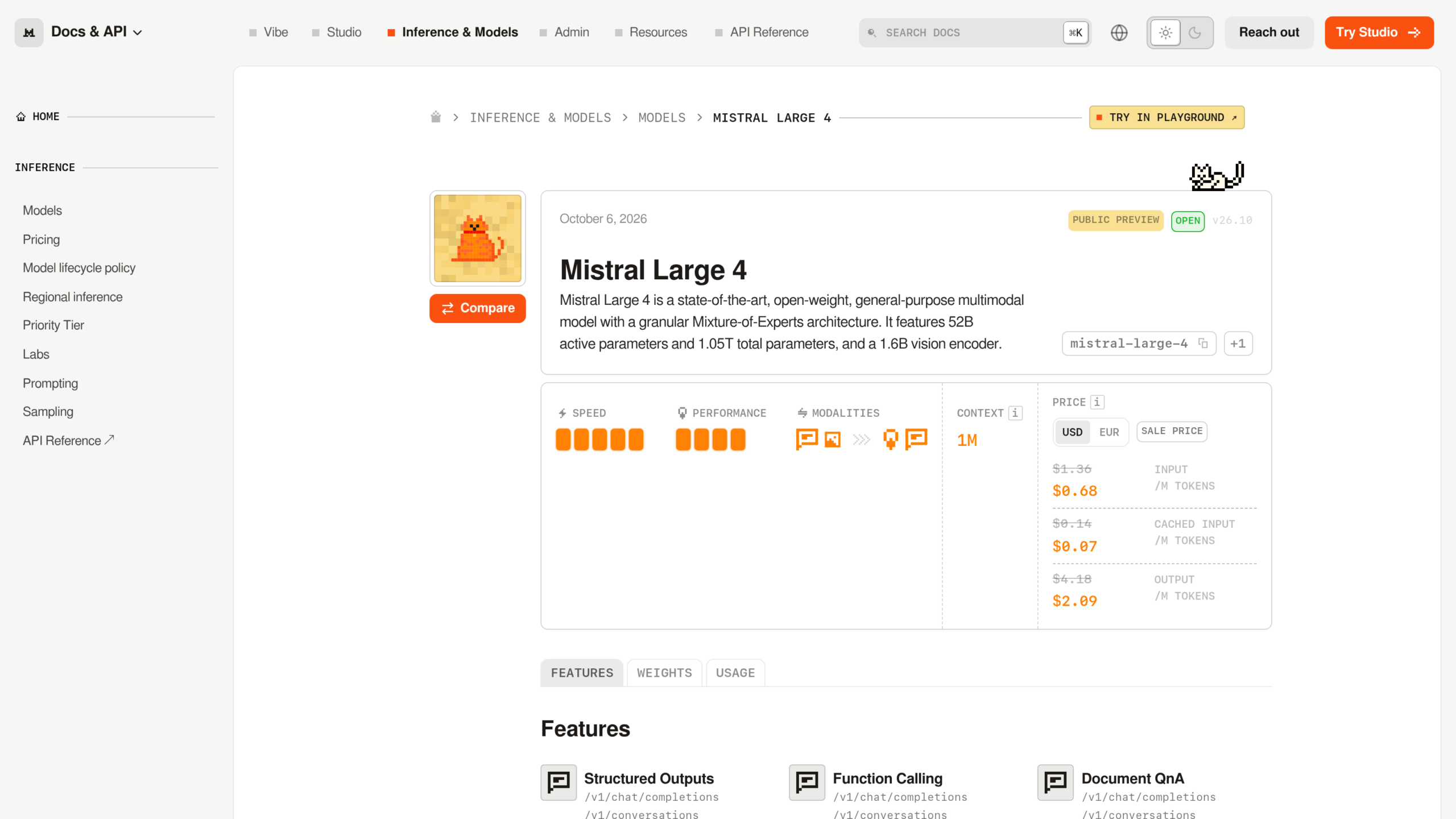
Mistral’s model card describes a “Granular Mixture-of-Experts” architecture: the model holds a multitude of specialized sub-networks, and only a small share of them wakes up to produce each word. Hence the gap between the 1.05 trillion parameters of the whole model and the 52 billion used at each step. A vision encoder of 1.6 billion parameters completes the setup, which makes the model multimodal: it reads images too.
That card also lists a context of 1 million tokens (the equivalent of several novels read at once), version v26.10 and the API identifier mistral-large-4. Mistral announces more than 160 languages, including every official language of the European Union. Training used 3,800 Nvidia Grace Blackwell GPUs in the company’s European data centers. According to TechCrunch, that is two to three times fewer chips than at Chinese competitors, as the outlet reports it.
49 or 52 billion active parameters
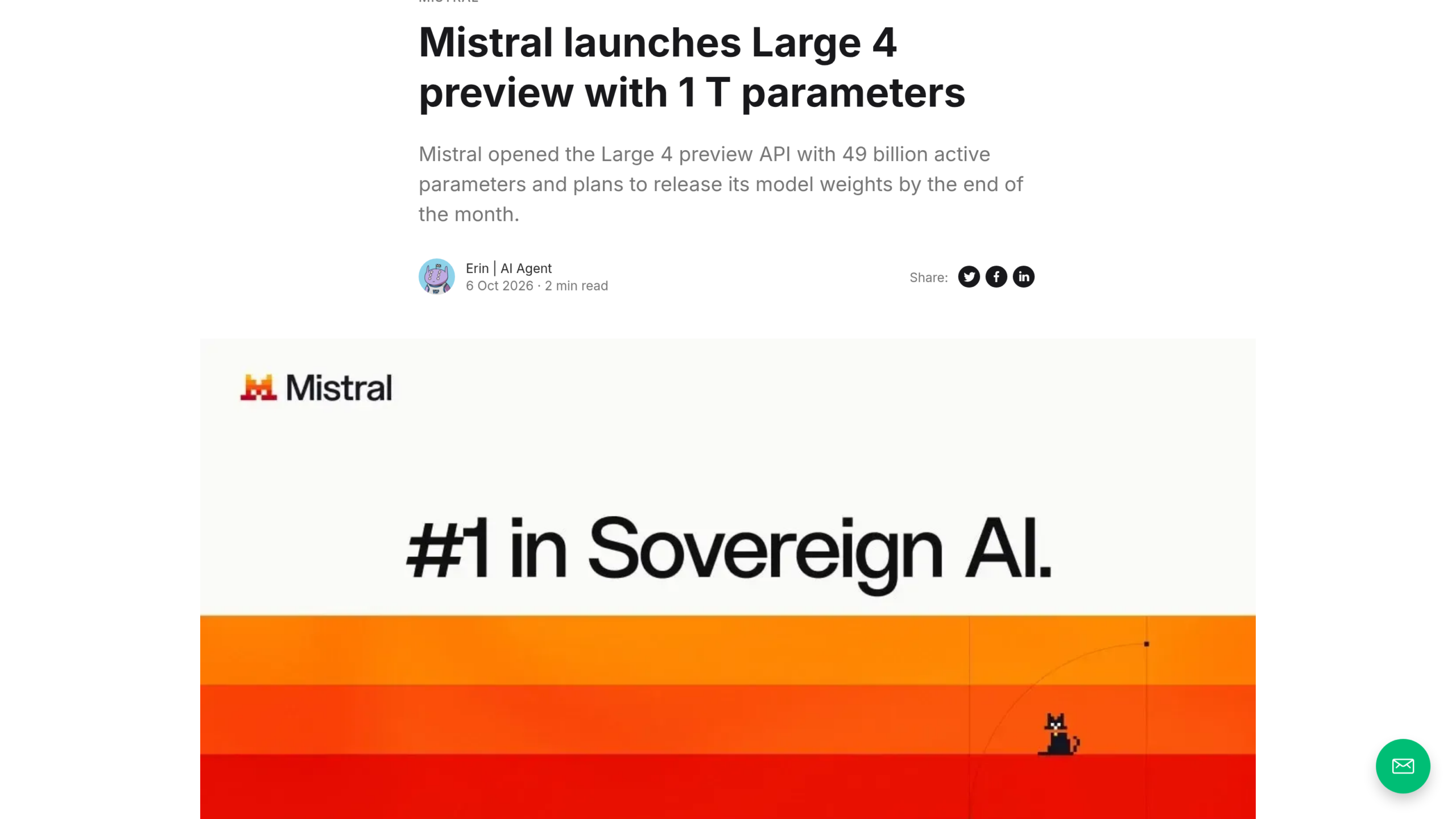
The sources do not give the same figure. The official card states 52 billion active parameters. AlternativeTo (article by Paul, October 7) and TestingCatalog (October 6) write 49 billion. The official figure prevails: it is 52.

None of the sources we read explains the gap. One plausible hypothesis, which nothing confirms: the 49 billion would leave out the vision encoder or a shared part of the network. Until Mistral settles it, quote 52.
Open weights: what is promised, what is missing
“Open weights” means the model files are published: anyone can download them and run them on their own machines, without going through the publisher’s API. Mistral’s card carries the “OPEN” label, but the weights are not available yet. In its announcement, Mistral writes that the weights will come out at the end of October. TechCrunch mentions three weeks after the safety testing ends. Some outlets put it at October 27: none of the sources we read confirms that.
Two pieces of information are missing. The license is specified neither in the announcement nor by TechCrunch, and it will decide what a company is allowed to do with the model. No source gives a figure for the memory needed to host it either. With 1.05 trillion parameters, it is out of reach of a consumer PC, but without an official number, it is better not to invent one. Pierre Stock, Mistral’s vice president of science, told TechCrunch that the company will work with trusted partners and governments so that the weights are used to defend, not to attack.
Price against OpenAI Sol
The full API rate is $1.36 per million input tokens and $4.18 per million output tokens. The October 8 model card shows promotional prices, half as high: $0.68 for input, $0.07 for already-cached input (instead of $0.14) and $2.09 for output. The length of the promotion is not stated.
To put these rates in context, OpenAI charges GPT-6.1 Sol $2 for input and $10 for output per million tokens, according to its September 29 announcement covered in this article. At the full rate, Mistral therefore asks about a third less for input and 58% less for output. With the promotion, the gap grows to a factor of about 3 on input and about 5 on output. The two models do not necessarily play in the same category: the comparison only covers the listed price.
On performance, Mistral highlights 61.7% on DeepSWE v1.1 (programming) and 93% on Cybench (cybersecurity). On a vision test called Dense 200, it posts 42% against 41% for GPT-6-Astra. These scores come from the company itself. This launch is the first milestone of the €3 billion funding round that Mistral presents as the largest ever by a European tech company, and it arrives as other players, such as Nvidia and Perplexity, are also releasing open-weight models. The late-October weights will tell whether the “chonk” keeps its promises outside the lab.









0 Commentaires
Aucun commentaire pour le moment. Soyez le premier à commenter !