
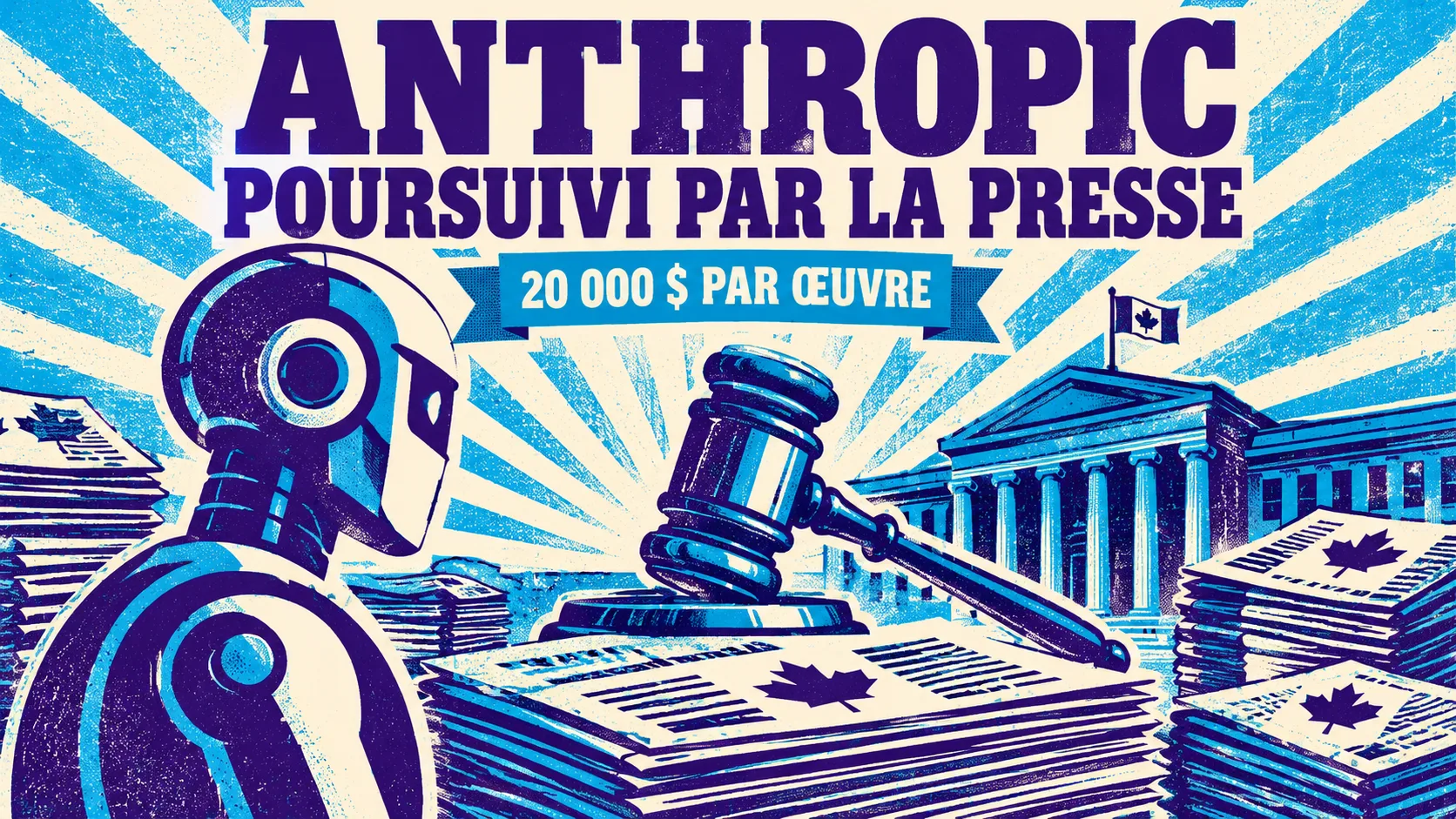
13.5 million. That is, according to the complaint, the approximate number of articles and news items that four Canadian groups claim Anthropic copied since 2021. Multiplied by the ceiling of 20,000 Canadian dollars per work that the plaintiffs are asking for, the result is 270 billion. That is the theoretical order of magnitude of the lawsuit against Anthropic filed on October 6 in the Ontario Superior Court. The facts are more sober: allegations, not a ruling.
Who is suing, and how the case came out
Trade site Cartt.ca revealed the complaint first, and it was detailed on October 14 by Broadcast Dialogue (Connie Thiessen). It was widely picked up on October 19, with CBC News and CTV News, which ran the wire story from The Canadian Press, the country’s English-language news agency.
Four groups are suing: Postmedia (with its subsidiary PNI Maritimes), Torstar (owner of the Toronto Star, with Metroland Media), The Globe and Mail and The Canadian Press. According to Broadcast Dialogue, the defendants are Anthropic and its Canadian subsidiary. CBC/Radio-Canada is not among the plaintiffs in this case, although it is in the parallel case against OpenAI.
What the publishers allege
The lawsuit against Anthropic rests on four claims: copyright infringement, breach of the sites’ terms of use, unjust enrichment and circumvention of technical protection measures (the paywalls and logins that limit copying). The publishers say Anthropic scrapes text (automatically copies web pages with a bot, here called ClaudeBot) to train its models, and keeps collecting it to answer user requests. The complaint says Anthropic « has done nothing to curtail its unlawful behaviour ».
What the publishers stress fits in one sentence: « Anthropic has yet to execute any form of public content licensing agreement with major publishers. » Anthropic did not respond to requests for comment, and none of the above has been proven in court.
The theoretical figure in the lawsuit against Anthropic
The publishers ask for general damages, the return of the profits made from this content or, failing that, statutory damages (an amount set by law, with no need to prove the loss) of up to 20,000 Canadian dollars per work. They add punitive damages and an injunction (an order to stop) barring access to their content without written consent. Broadcast Dialogue reports that the complaint speaks of « potentially billions » in damages.
The volumes alleged since 2021: The Canadian Press 4.2 million works, Postmedia and PNI Maritimes 3.5 million, Torstar 3.5 million, The Globe and Mail 2.3 million. The 13.5 million total is our own addition, not a figure from the complaint. At the 20,000-dollar ceiling, it gives 270 billion Canadian dollars. That product has no forecasting value: part of these texts is only licensed to the publishers, and the court sets the amount per work itself.
For reference: in the American case Bartz v. Anthropic, brought by authors, the 1.5 billion dollar settlement received final approval on July 20, 2026, about 3,000 dollars per work according to the Authors Guild. The Canadian ceiling is nearly seven times higher, but a ceiling is not a settlement.
An Ontario court already seized against OpenAI
The lawsuit against Anthropic is not the first of its kind in Ontario: the same groups, with CBC/Radio-Canada, sued OpenAI in 2024, and that case is not settled. On November 7, 2025, the Ontario Superior Court found it had jurisdiction over six OpenAI entities, according to The Canadian Press wire story of November 27. That ruling concerned jurisdiction, not the merits: no Canadian court has yet said whether training an AI on news articles breaks the law. Anthropic had not yet filed a defence as of October 14: a defendant located outside Ontario has 60 days to respond.
What changes in Europe
For a French reader, a lawsuit against Anthropic would follow a different legal route. The 2019 European copyright directive provides, in its Article 4, a text and data mining exception (the automated analysis of large volumes of content): a rightsholder can object by reserving their rights, which is the opt-out mechanism. The Canadian complaint, for its part, relies on the terms of use and the circumvention of technical protections.
The question is not settled in Europe. A Budapest court referred the matter to the Court of Justice of the European Union in April 2025, in Like Company v. Google (C-250/25), to ask whether training a chatbot is reproduction and whether Article 4 covers it, according to the law firm DDG. In France, the SNE, the SGDL and the SNAC announced on March 12, 2025 an action against Meta before the Paris judicial court, which Livres Hebdo reported. We found no ruling on the merits in either case.
In the lawsuit against Anthropic, the next known deadline is the company’s response, expected within 60 days of the complaint being served. It is not its only legal front: we covered its standoff with the Pentagon.









0 Commentaires
Aucun commentaire pour le moment. Soyez le premier à commenter !