
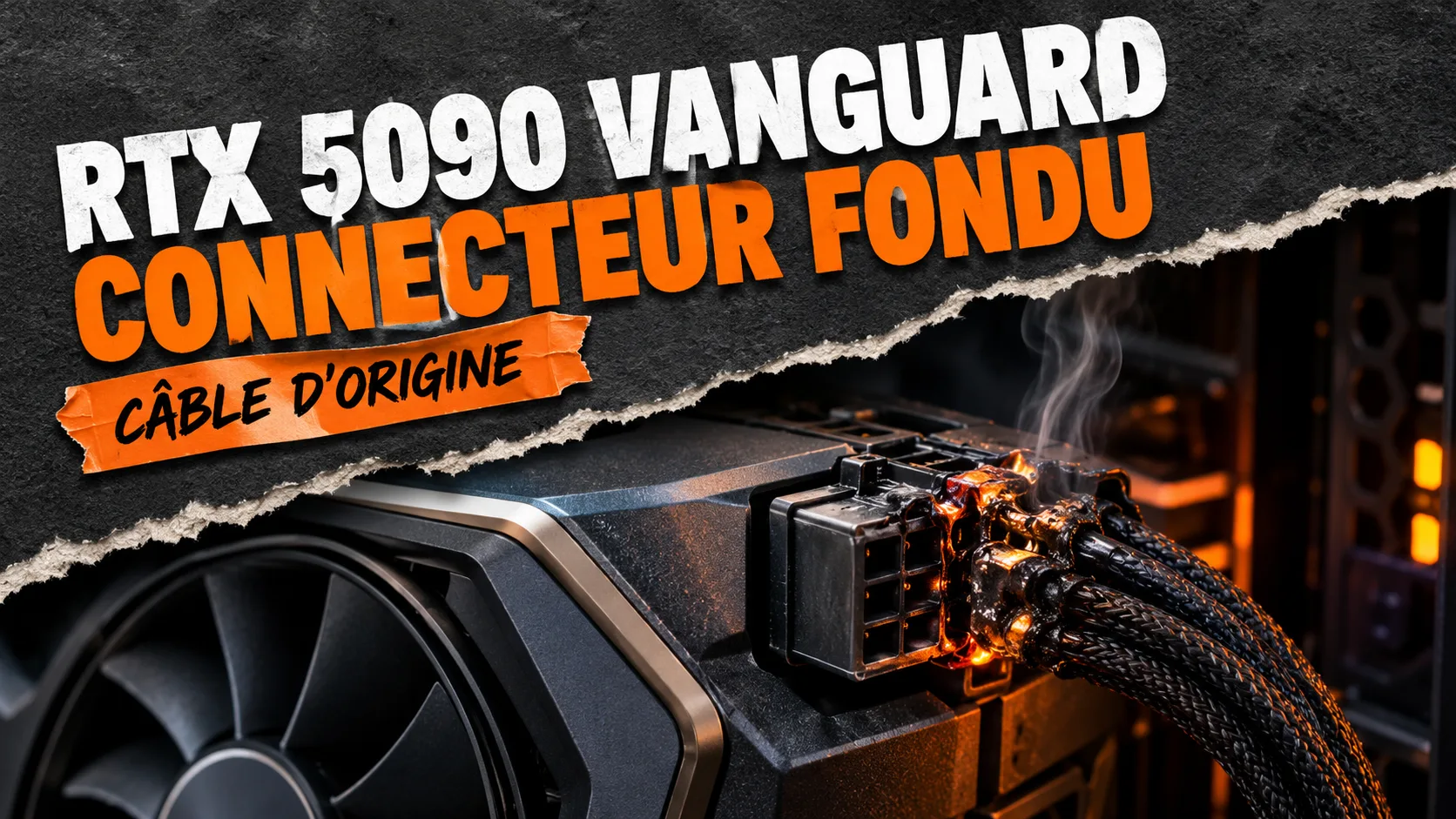
A burning smell, then no picture: on an MSI RTX 5090 Vanguard, the 12V-2×6 connector (the 16-pin power plug of RTX 50 graphics cards) melted while the card was plugged in with its original cable, with no adapter. The case dates from October 21, 2026 and we found it only at GameGPU, which points to a message from the X account @unikoshardware that we could not read ourselves. No other outlet covered the incident in our searches, and we found no reaction from MSI.
What the RTX 5090 Vanguard case describes
According to GameGPU (Evgen Kovalov, October 21), the card ran on a 1,000 W FSP Hydro GT Pro power supply. The owner smelled burning while the PC was running, then the card stopped working. The inspection shows the plastic housing of the plug melted and the contact block (the part that holds the metal pins) damaged. The most visible deformation, according to the description of the incident, is on the top row of contacts. The heat reportedly damaged both the cable plug and the connector on the card.
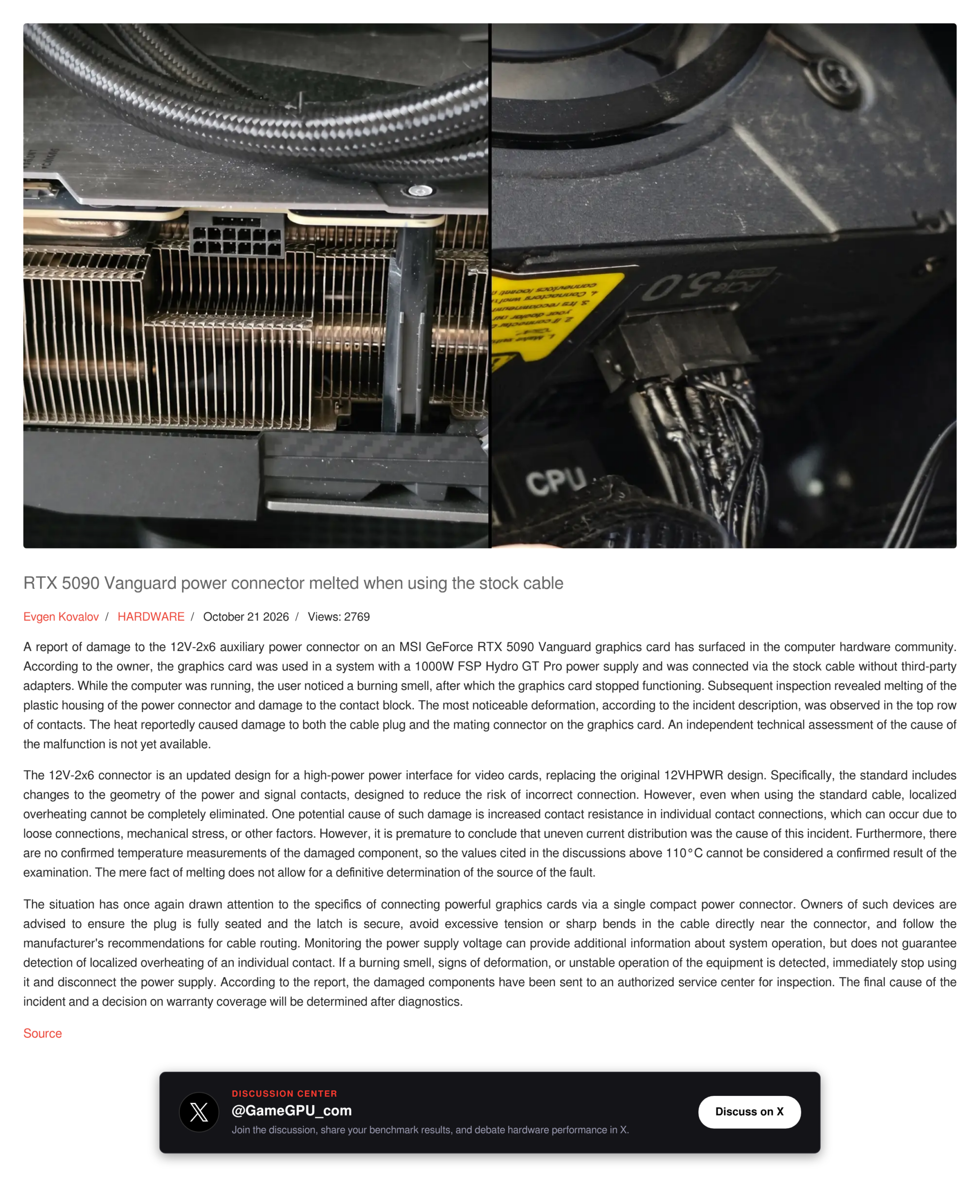
The damaged parts were sent to an authorized service center. The final cause and any warranty decision will depend on its diagnosis. The power the card was drawing at the time is not stated anywhere.
What nobody has established yet
GameGPU writes: “An independent technical assessment of the cause of the malfunction is not yet available.” The outlet considers it premature to conclude that current was unevenly spread between the pins, the explanation most often heard for these meltdowns. It points out that higher contact resistance (a junction that lets current through poorly and heats up) can come from a plug that is not fully seated, from mechanical stress or from other factors.
To understand the uneven-current hypothesis, Tom’s Hardware noted in April 2025 that each of the six power pins is limited to 9.5 A, and that reference RTX 50 cards do not measure current pin by pin, so they cannot rebalance the load. Nothing indicates that this mechanism is involved here.
Temperatures above 110 °C are circulating in discussions. GameGPU states that no measurement has been confirmed on the damaged part, so we do not treat them as a result. According to the outlet, the mere fact that the plastic melted does not identify the origin of the failure. The word “original” is also vague: GameGPU refers to the standard cable without saying whether it came with the card or with the FSP power supply.
After third-party cables, an original cable
This follows three cases already covered here: the cable that melted during a DLSS 5 test on an MSI RTX 5090 Gaming Trio OC, at more than 610 W; PNY’s warranty refusal for a card that melted with the native cable of a 1,600 W power supply; and the RTX 5090 pushed to 900 W after a hand-soldered modification, without the original 16-pin plug.
Tom’s Hardware (Andrew E. Freedman, October 3) added a $5,245 prebuilt PC whose RTX 5090 cables melted after a year in its box. According to the article’s headline, Digital Storm and PNY denied the warranty over expired coverage and third-party cables.

The RTX 5090 Vanguard case differs on one point: no adapter and no separately bought cable, according to the owner. The third-party cable argument, raised in the two previous cases, therefore does not apply to his account, subject to what “original” exactly means.
What you can check on your own machine
GameGPU lists general precautions. They do not address the cause, which remains unknown, but they reduce the risks the outlet identifies:
- push the plug in fully and check that the latch (the small locking clip) is engaged;
- avoid any pulling and any tight bend of the cable right next to the connector, and follow the manufacturer’s cable-routing guidance;
- monitor the power supply voltage, keeping in mind that GameGPU says this is informative but does not guarantee detecting localized overheating on a single contact.
Burning smell, deformed plastic or an unstable machine: turn the PC off and unplug the power cord before touching anything. Do not try to take apart or repair the cable yourself. Photograph everything before touching anything: this tip is ours, and it will help if you open a warranty claim.
Warranty when the cable is the manufacturer’s
In the PNY case, the refusal rested on where the cable came from: according to the customer’s message, only PNY-brand cables and adapters, those supplied with the card, were covered. A cable supplied with the card falls outside that scope. For the RTX 5090 Vanguard, we have not read MSI’s warranty terms and do not know what they say about cables or power supplies. GameGPU says only that the decision awaits the service center’s diagnosis.
The financial stakes are heavy: our article on Nvidia’s denial noted listings above $8,000 on Amazon and Newegg for a card sold at $1,999 at launch. As of October 23, we have found no published diagnosis from the service center.








0 Commentaires
Aucun commentaire pour le moment. Soyez le premier à commenter !