

On Friday, October 30, 2026, 35 of 577 deputies vote. Eleven votes to ten are enough to adopt a data tax of 0.055 euro per gigabyte sent to French internet users.
Since then, social networks have been passing around figures. Downloading GTA 6 would cost €11.55, the tax would have cost ZEvent €2 million, and Twitch would leave France the way it left South Korea. To establish who would pay this tax and what it could cost players, streamers, subscribers and operators, this article relies on the official text of the amendment, the vote, the session record and data from Arcep (France’s telecom regulator).
What amendment I-1358 really says
Amendment no. I-1358 to the 2027 finance bill was tabled on October 9 by Laurent Lhardit, a Socialist deputy, and co-signed by his entire group. It was adopted on October 30 by the National Assembly, at first reading (the text’s first pass before the deputies). It creates in the general tax code a “taxe sur les producteurs de données numériques” (a tax on digital data producers).

The payer is the sender, meaning the content provider. Neither the internet user nor their internet provider is targeted. The providers, for their part, do the measuring, under the supervision of Arcep (the telecom regulator) and the DGFiP (the French tax authority). Each quarter they report the quantities of data sent to their customers, sender by sender, in an anonymized collection. No record of the content or the destination can be demanded.
When a sender goes through a CDN (cache servers installed close to subscribers, like those of Akamai), the quantity counted is the sum of the flows leaving the CDN. The rate is 0.055 euro per gigabyte. The amount due is capped at 15% of revenue earned in France or 2% of total revenue, and the text does not say which of the two applies when they differ. It sets no minimum threshold, so small senders get no exemption.
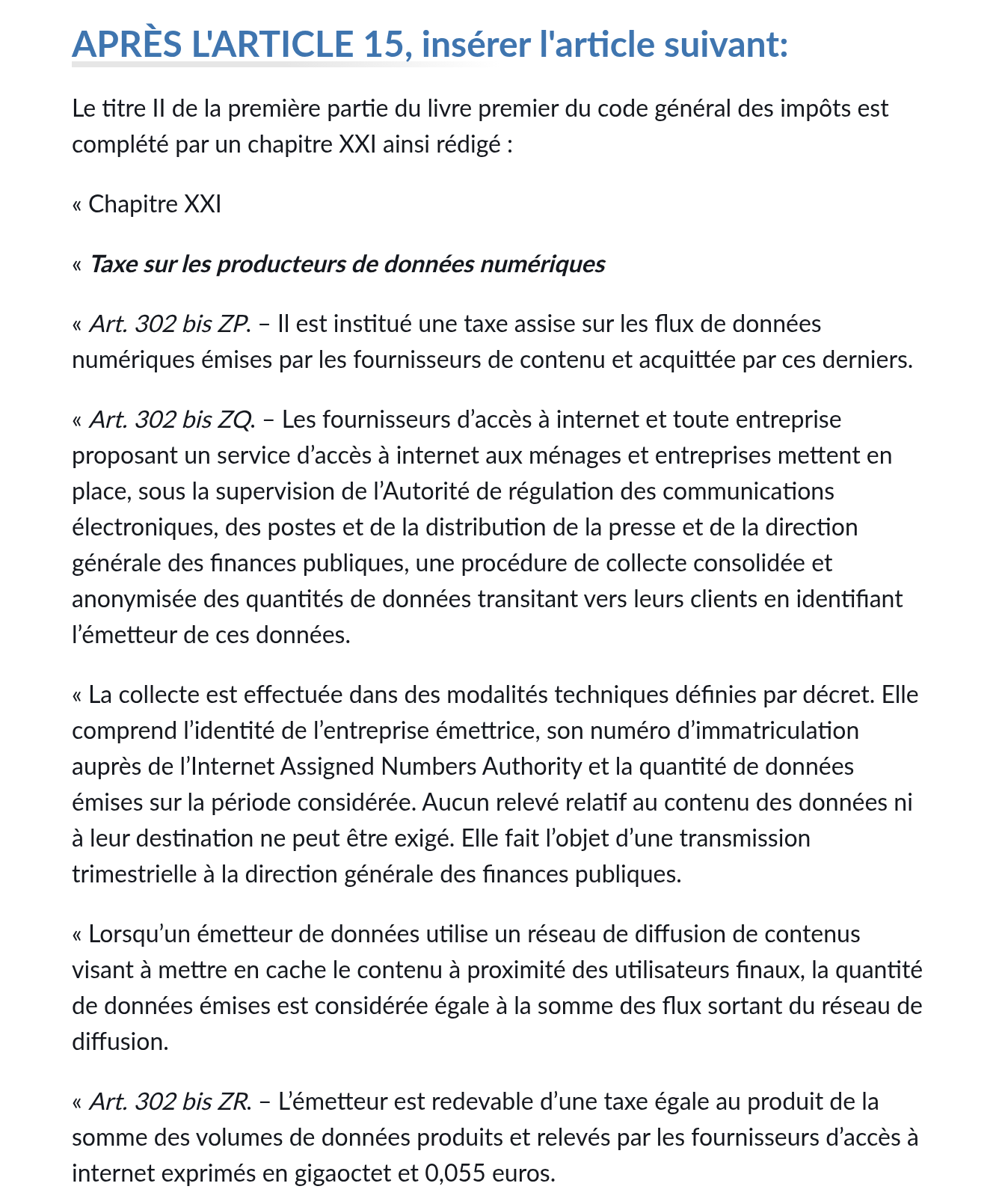
National Assembly: article 302 bis ZR sets the data tax at 0.055 euro per gigabyte sent to French subscribers.
The statement of reasons (the written justification for the amendment) targets revenue of 10 billion euros. It attributes to Arcep an estimate of 200 billion gigabytes a year toward subscribers, which gives 11 billion euros gross before caps. That figure does not appear in Arcep’s public press release, which measures traffic as bitrate.
According to the same statement, Google, Meta, Amazon, Netflix and Akamai alone would account for half of the traffic, and most of the data tax would be paid by “the major international players of Tech and digital”. The cap was designed for sectors that send a lot of data per euro of revenue, such as video on demand and video games.
A vote with 35 deputies out of 577
Friday, October 30, 2026, first sitting, in the morning. The Socialist group requests a public ballot (an electronic roll-call vote in which every ballot is published). The count comes in: 35 voters, 21 votes cast, 11 for, 10 against and 14 abstentions. The amendment passes by one vote.
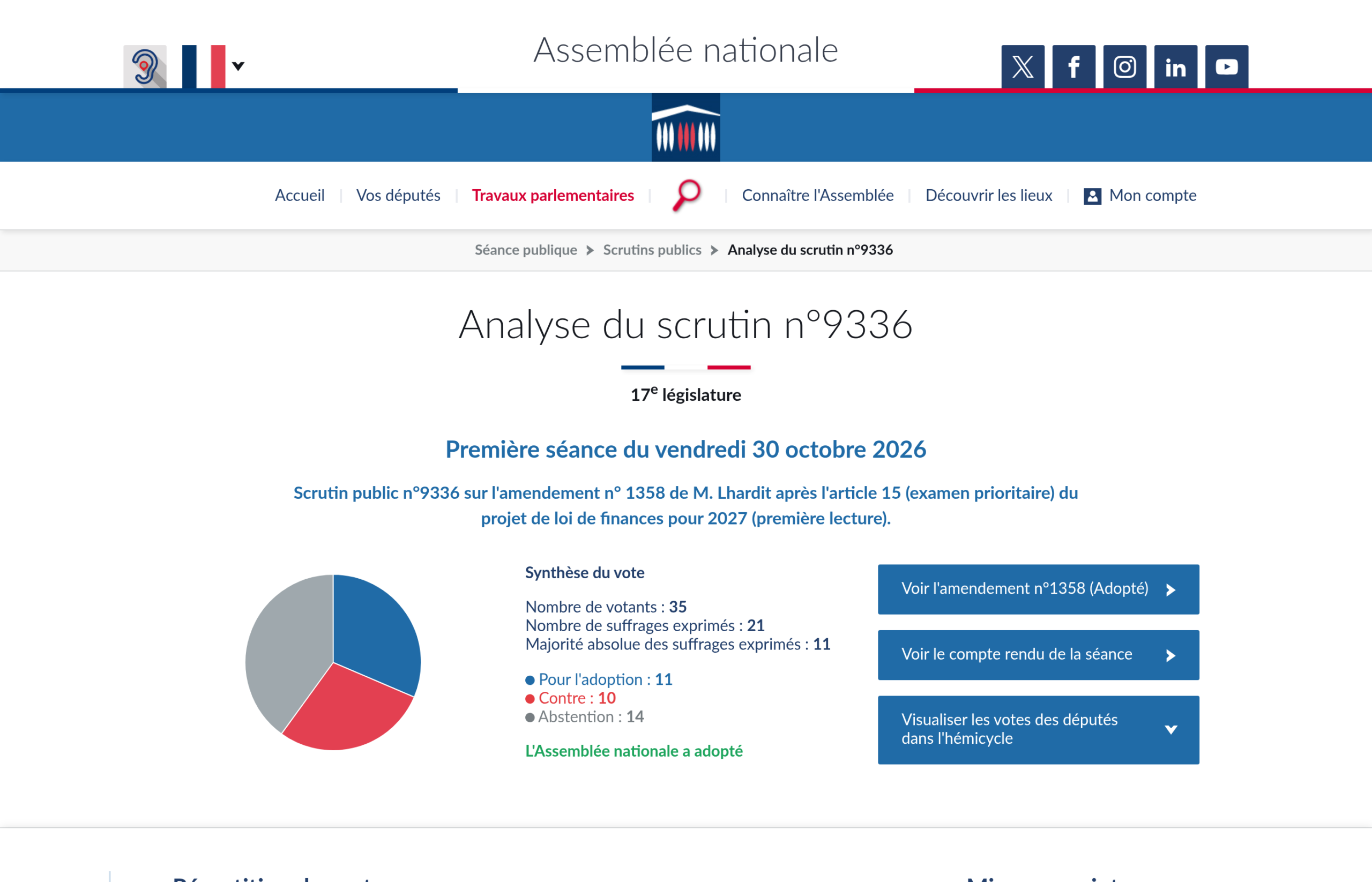
The tally shared since Friday (about thirty voters, about ten abstentions, only Socialists voting for) is approximate, and the votes for do not all come from the Socialist Party (PS).
- For, 11 votes: 5 Socialists, 2 from LFI (La France insoumise, the radical left), 2 Greens and 2 from the GDR group (communists and overseas deputies).
- Against, 10 votes: 5 from the Droite républicaine (the Republican Right), 4 from Ensemble pour la République (the presidential camp) and 1 from Les Démocrates.
- Abstention, 14 votes: 10 from the Rassemblement national (RN) and 4 from LFI.
No deputy from LIOT, the UDR or the unaffiliated voted.
A single vote would have changed everything. If just one of the ten RN members had voted against instead of abstaining, there would have been 22 votes cast, a majority set at 12 and only 11 for. The amendment would have fallen.
Two unfavorable opinions preceded the vote, as the record of the sitting shows. Philippe Juvin, general rapporteur (the deputy in charge of presenting the finance committee’s opinion), pointed to the market power of the tech giants (the Gafam): “The risk is that they pass the weight of this tax on to advertisers.” David Amiel, minister for public action and accounts, mentioned “flow sensors” to be installed. He added that half of the tax, “still 5 billion euros according to your proposal”, would not weigh on the digital giants “but on smaller content providers, notably French providers”.
GTA 6 at €11.55: the math is right, the bill’s recipient is not
A calculation has been circulating on social networks since Friday. Downloading GTA 6 would cost €11.55, and as much again to redownload it because of a DLC, hence the advice to keep it on your PC. The 210 GB figure comes from the PlayStation Game Size account, which spotted it in PlayStation Store data, Xboxygen reports. Rockstar has confirmed nothing.
The arithmetic holds up. At €0.055 per gigabyte, 210 × 0.055 does give €11.55. The details of that size are in the article on the 210 GB of GTA 6 on PS5.

The data tax would be owed by the sender of the file, meaning Sony via the PlayStation Store, Microsoft for Xbox, or the CDN (the network of servers close to subscribers that delivers the file), such as Akamai. The amendment’s summary statement leaves these intermediaries free to pass the tax on or not. The player is not the taxpayer and nothing would appear on a subscription bill.
Its cap is computed on the sender’s revenue, not per download. On the other hand, every redownload or update adds to the taxed volume, which gives the sender a reason to pass the sum on in its prices. The game comes out on November 19 on PS5 and Xbox Series X|S, with no PC version announced at launch.

For the player, everything would depend on what Sony or Microsoft did with the sum.
In South Korea, network fees drove Twitch out
According to Next, Twitch ceased all activity in South Korea on February 27, 2024. Its CEO, Dan Clancy, had given the reason: “Twitch operates in Korea at a loss and we unfortunately see no solution”. The platform cited network fees ten times higher than in most other countries.
Before reaching that point, Twitch had capped resolution at 720p, a reduced image definition. The platform had also tested a peer-to-peer model, in which viewers themselves relay part of the stream.
After the shutdown, Korean users can no longer buy Twitch’s paid products, and the country’s streamers no longer earn money there. Many joined Chzzk, Naver’s platform, or AfreecaTV, now SOOP. The Korea JoongAng Daily, a South Korean daily published in English, describes the race by local platforms to attract these creators.
The mechanism differs from that of the French amendment, though. In South Korea, service providers, foreign ones included, pay network fees to operators, and the State collects nothing. Netflix sued the operator SK Broadband in 2020, lost in 2021, then reached a deal in 2023. With the data tax in amendment I-1358, the State collects, and operators merely measure volumes.
Laurent Lhardit claims this difference. According to the record of the sitting, his scheme “overcomes the obstacles that made similar attempts fail in Canada or South Korea”.
In South Korea, Twitch first degraded its service, then left the country.
The €2 million ZEvent figure does not hold up
ZEvent got its own calculation too. Its latest edition reportedly consumed 50,000 TB (terabytes, 1,000 GB each), which would make a data tax of €2 million. The multiplication gives something else. 50,000 TB is 50 million GB, and 50 million × €0.055 comes to €2.75 million. As for the 50,000 TB volume, neither ZEvent nor Twitch has published any data to back it.
Twitch (so Amazon) would pay, as the sender of the streams. Neither the event, nor the streamers, nor the donors would owe anything. Only traffic delivered to subscribers of French internet providers would count, not that of Belgian, Swiss or Quebec viewers.
The September 2026 ZEvent was the tenth and final edition, with 32,891,874 euros raised according to L’Info Durable. The example therefore concerns an event that will not happen again.
The tax reduction on donations is 66%, not 67%, for a public-interest organization, capped at 20% of taxable income. It rises to 75% up to €2,000 for aid to people in difficulty, as Service-Public (the French government’s public information site) states. This reduction lowers donors’ income tax. It has no connection with a tax that Twitch would pay. The “6 million” reasoning adds up two unrelated money flows. The total measures nothing.
“These services are free”: precedents say the opposite
In the record of the sitting, Laurent Lhardit, first signatory of the amendment, dismisses the pass-through objection. He says: “I find it hard to see how a tax could be passed on to users of Facebook, Instagram or TikTok since these services are free”. The general rapporteur then shakes his head in denial.
A service that is free for the user still has paying customers, the advertisers, who buy ad space. That is where the general rapporteur, Philippe Juvin, placed the risk.
Meta provides a recent example. The Media Leader reported on March 10, 2026 that the group passes the French digital services tax on to advertisers, about 3% of advertising budgets. Amazon had done the same in 2019, three weeks after that tax was adopted, announcing a 3% increase in its rates for French sellers, reported the Blog du Modérateur. On October 1, 2019, its commission on each sale went from 15% to 15.45%, according to Clubic.
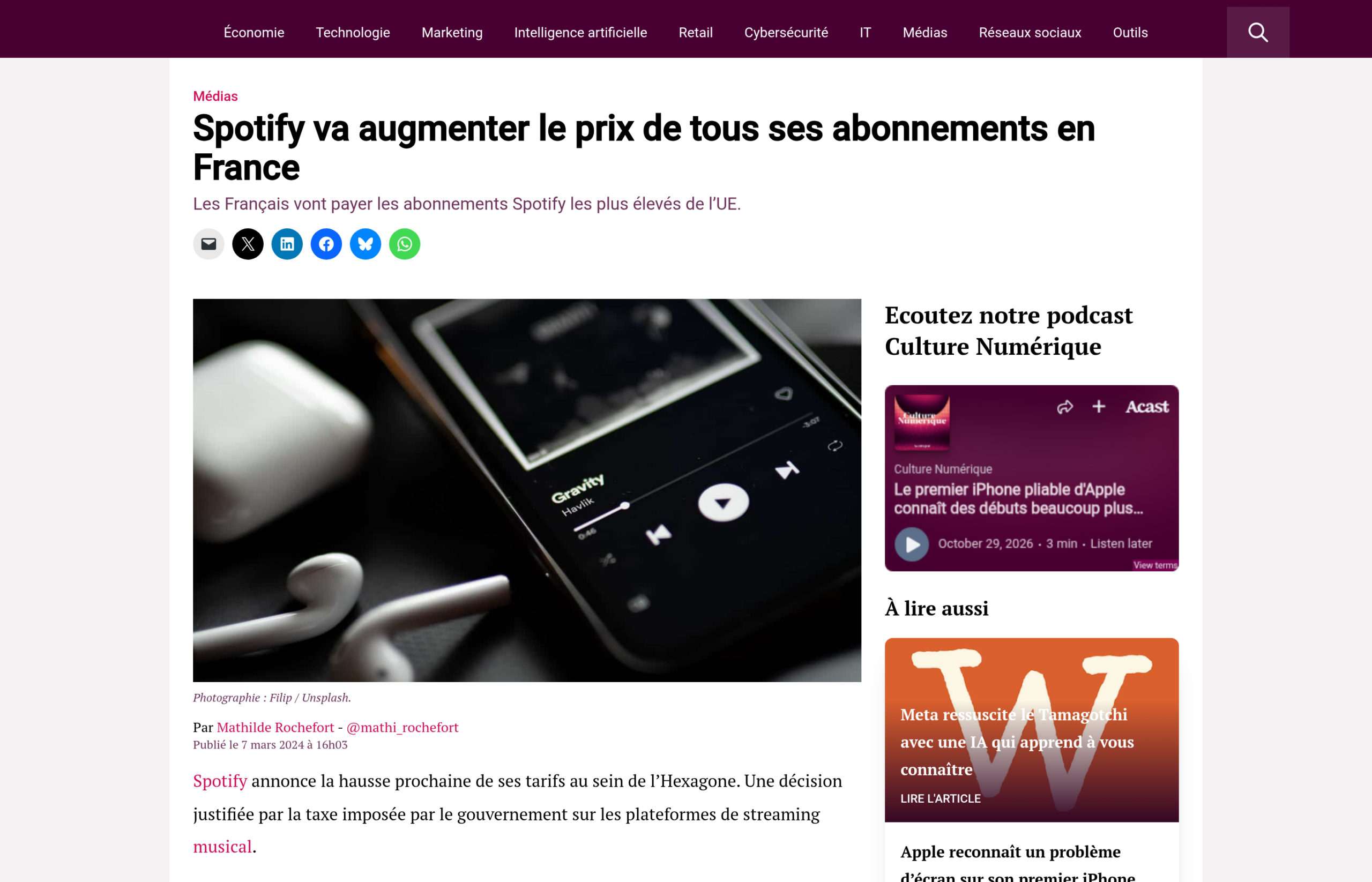
On the subscriber side, the clearest case dates from 2024. The streaming tax, set at 1.2% of revenue earned in France to fund the Centre national de la musique (CNM, the national music center), ended up on bills. As early as March 7, 2024, Siècle Digital reported that Spotify would raise the price of all its French subscriptions. At the end of May, Tom’s Guide noted the new price list, with the Personal plan going from €10.99 to €11.12 and the Family plan from €17.99 to €18.21. Spotify also warned that “in the future, further increases in the CNM tax will be reflected in our pricing plans in France”.
The budget that carries the data tax contains another case. Its article 16 raises VAT on TV subscriptions from 10% to 20%. The finance committee removed it on October 9, but it is back in the text examined in the sitting. According to Selectra, Canal+ CEO Maxime Saada plans to pass on “exactly the amount of the VAT”, but “not before 2028 or 2029”.
Players, streamers, subscribers, operators: who would pay the data tax
The taxpayers would be content senders, small ones included. The five biggest (Akamai, Netflix, Amazon, Google and Meta) account for 49% of traffic to users, according to Arcep, the telecom regulator. According to minister David Amiel, half of the sum would fall on smaller providers, notably French ones. Laurent Lhardit, author of the amendment, puts the cost for TF1 between 200,000 and 300,000 euros. These are two estimates, each from one camp.
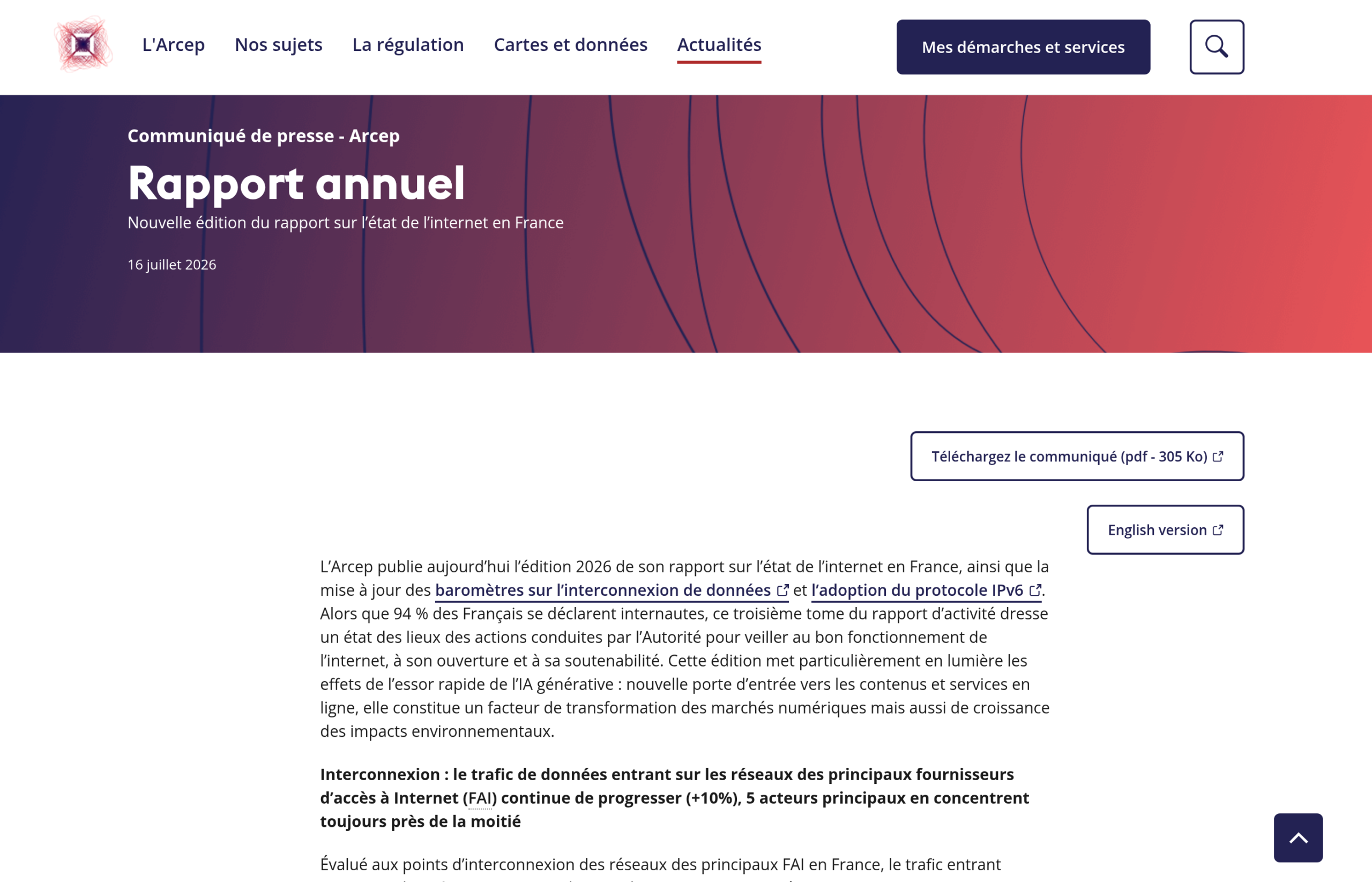
Arcep, July 16, 2026: five players concentrate nearly half of the incoming traffic at internet providers.
Streamers and YouTubers are not taxpayers. Twitch and YouTube would be. The risk for creators is indirect. It would concern streaming quality, revenue sharing or the very presence of the platform, as South Korea showed. No platform has announced any measure for France to date.
On the player side, downloads and updates from the PlayStation Store, Xbox or Steam would feed the senders’ volume. The statement of reasons, the justification written by the amendment’s authors, itself lists video games among the sectors that send a lot of data for every euro of revenue.
On the box or mobile plan bill, the data tax would change nothing directly. As an order of magnitude, and if everything were passed on, which is far from certain, the Arcep observatory relayed by Bbox-Mag allows a calculation. A 4G/5G box uses 248 GB a month on average, which is €13.64 of tax generated per month. A SIM card, the chip of a mobile plan, uses 19.3 GB, or €1.06. Spread over the 33.1 million internet subscriptions, the 10 billion targeted come to about €300 per subscription per year. The caps, for their part, reduce the sum due.
Orange, SFR, Bouygues Telecom and Free would not pay the tax. They would, however, have to build the measurement system, under the supervision of Arcep and the DGFiP, the tax authority. That is the minister’s technical objection. The amendment does not put a figure on that cost.
What can still happen to the text
“It will be rejected anyway”: the forecast is already circulating, and the calendar gives it several chances to be put to the test.
The amendment is not a law. It was adopted at first reading (a text’s first pass before an assembly), in the first part of the budget, the revenue part. The Assembly’s solemn vote on the whole text is scheduled for November 17, according to Toute l’Europe.
On the night of November 21 to 22, 2025, the Assembly had rejected the revenue part of the 2026 budget by 404 votes to 1, which brought down the whole text at first reading, as LCP recounts. The government then used 49.3 (Article 49.3 of the French Constitution, which lets the government pass a text without a vote, choosing which amendments it keeps) in January 2026 to pass the budget.
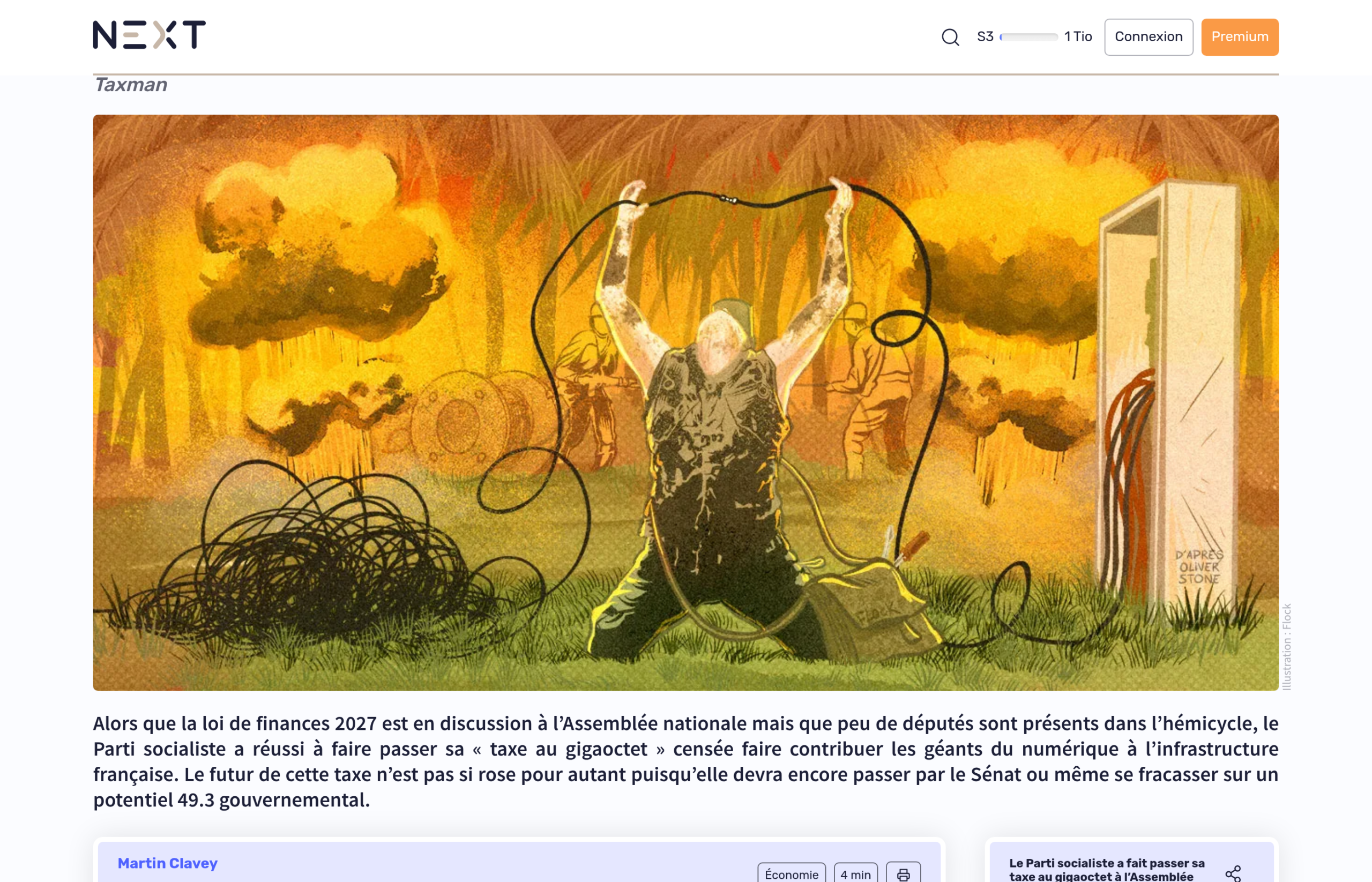
Two exits are taking shape, according to Next. The Senate, with an LR majority (Les Républicains, the right), where adoption is considered unlikely. And 49.3, which the Assembly’s president, Yaël Braun-Pivet, has urged Prime Minister Sébastien Lecornu to use. The government, which gave an unfavorable opinion, is not required to take up the amendment.
A data tax could also attract trade retaliation. In July 2020, Washington announced 25% tariffs on about 1.3 billion dollars of French products (cosmetics, handbags) in response to the digital services tax, before freezing them and then suspending them in January 2021, reports Europe 1. Amendment I-1358 says nothing about this risk.





0 Commentaires
Aucun commentaire pour le moment. Soyez le premier à commenter !