

Four versions in three months, two of them on the Steam page. That’s what Sega has produced to explain its use of generative artificial intelligence (technology able to produce text or images from a simple prompt) in Crazy Taxi: World Tour. The game was revealed in early June 2026 at the Xbox Games Showcase, under the direction of Kenji Kanno, the creator of the original series. Since then, the AI disclosure has been rewritten, two clarifications have been given to the press, and journalists who tried the game at gamescom mention it less and less.

An AI Disclosure on Steam, an Immediate Reaction
From the moment Crazy Taxi was revealed, the game’s Steam page carried an « AI Generated Content Disclosure » section, where Sega stated it used generative AI as a support tool for its developers. The series was returning after a long absence: its last console entry dates back 24 years, and the original had been delisted from digital stores, which already made this comeback sensitive before the AI question even came up.
GamesRadar reacted as early as June 7. Its headline set the tone: « Sega stuffed generative AI into Crazy Taxi: World Tour, slamming the brakes on all the excitement after a 3-year wait. » The article by Scott McCrae for GamesRadar opened with five repeated words: « No no no no no. » Sega had also just closed its Rovio Copenhagen studio, three years after acquiring it.
Sega Completes Its Explanation in Two Days
On June 7, 2026, Sega added a first clarification. The publisher told Game Informer that « Assets were still subject to review by the development team, » a line absent from the original text. The next day, an interview with Kenji Kanno by Kotaku spelled out the exact role AI played in the game.

According to Kanno, generative AI is only used « as a reference, » and everything that ends up in the game is « made by an actual human. » It was Shacknews, written by TJ Denzer, that tracked both updates as they happened, in an article regularly updated between June 7 and June 8.
What Crazy Taxi’s Steam Page Says Today
Captured on September 9, 2026, the game’s Steam page shows yet another version of the text. Sega now presents generative AI as an optional support tool, meant to free up more time for teams to focus on creative tasks. The key line reads: « generative AI was used as part of the ideation process for background objects. However, no AI-generated content will be included in the final game. »
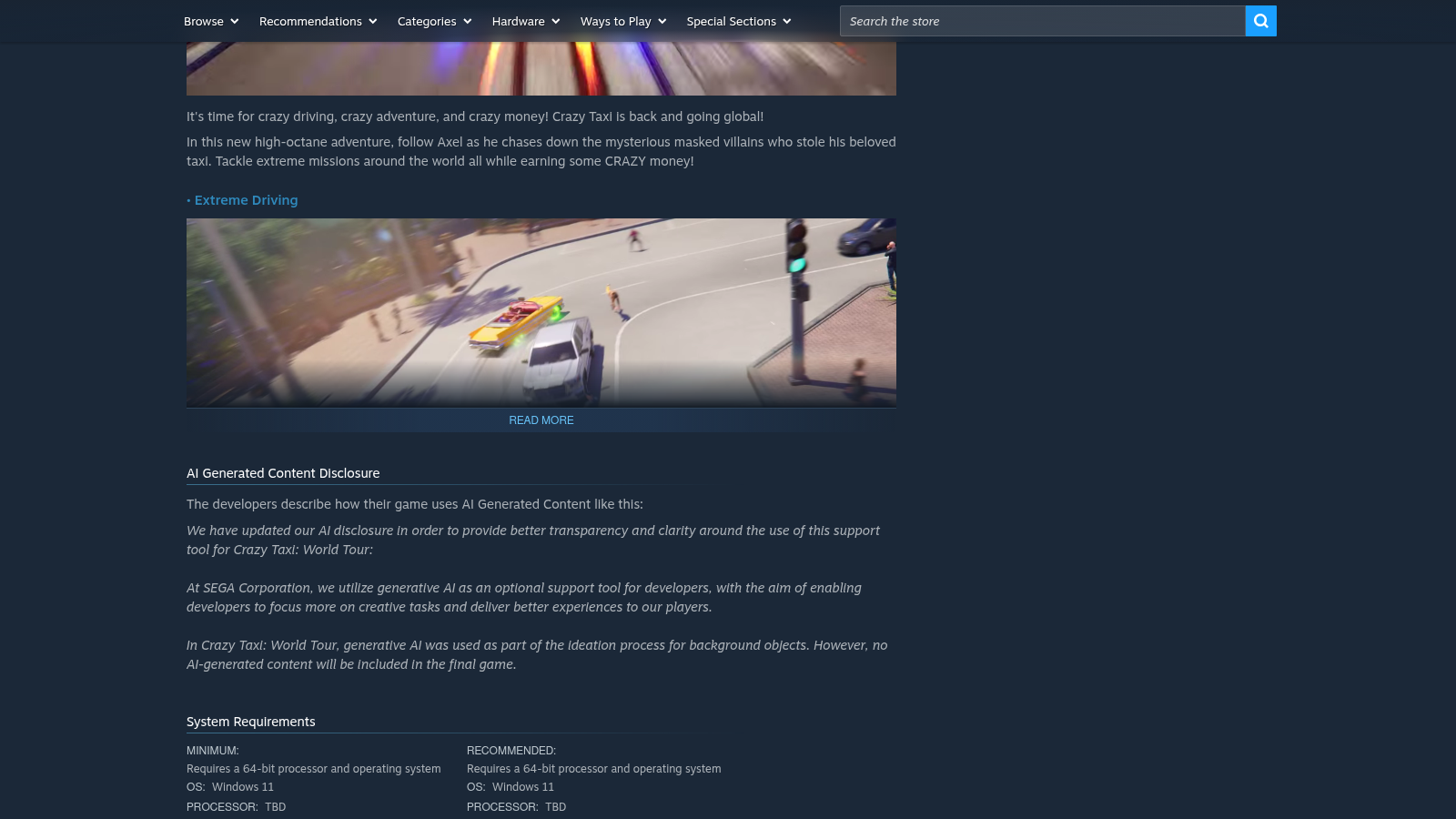
Four versions have followed one another, each with a different nuance. In early June, the Steam page presented AI as a simple support tool. On the 7th, human review was added to the statement given to Game Informer. On the 8th, Kanno narrowed AI down to a « reference. » By September, the rewritten Steam page limited it to background objects and excluded it from the finished game. Crazy Taxi: World Tour is still expected in 2027 on PC, PS5, Xbox Series X|S, and Switch 2.
The Germany Map, With No End Screen
The first public preview arrives on August 26, 2026, written by Ozzie Mejia for Shacknews. The journalist drives through the new Germany map and finds familiar sensations: the original soundtrack from The Offspring and Bad Religion still plays during runs. The real novelty lies in the timer: once it runs out, there’s no more end screen, the game simply continues in the open world.

Side quests dot the map, like driving a pizza delivery guy across town or launching a wingsuit-wearing man into the air after a sudden braking move called « Crazy Stop. » Mejia does note, though, that the game « doesn’t look like it’s advanced much, from a visual perspective, since 1999. » Crazy Taxi’s closed network test, a multiplayer trial reserved for a limited group of players, is scheduled for September 11 to 13, ahead of a full 2027 release.
Kenji Kanno Promises « a Surprise »
On September 3, 2026, Push Square publishes its own preview, written by Sammy Barker, who tried a very early PS5 build. Cologne Cathedral appears in the Germany map, alongside a central train station. The finished game will feature five locations in total, including the return of San Francisco, the city from the original game.

Barker also asks Kanno about the characters’ new designs, which are more clothed than in the original. The creator answers: « the characters in the original game were half naked, so we thought it was better to have them wear something. » Asked about the soundtrack, he promises « there’ll be a surprising announcement real soon. »
On September 2, 2026, TheGamer gathers another confession. Rumors had suggested a Fortnite-style live-service mode (a game whose content keeps evolving after release), but Kanno tempers that: « I don’t want everyone to play the multiplayer mode, » before adding that « another giant surprise » is waiting for the soundtrack.
Eurogamer Buries AI in the Twelfth Paragraph
On September 9, 2026, American outlet Aftermath revisits an editorial choice. An Eurogamer preview, published the previous week, was headlined: « Gen-AI controversy aside, after 30 minutes with Crazy Taxi: World Tour, it feels like classic arcade Sega – and it’s an absolute blast. » The AI topic only shows up in the twelfth paragraph, out of twelve total.

Eurogamer’s article drew over a hundred comments, mostly hostile to that headline choice. A few days later, the same outlet published impressions on 1666: Amsterdam, another game linked to generative AI, with a line: « There’s the AI stuff in the game, of course, which is just as miserable as always. » For Crazy Taxi, the disclosure amounts to one line at the bottom of a Steam page. Whether it deserves a headline or a twelfth paragraph remains an open question.









0 Commentaires
Aucun commentaire pour le moment. Soyez le premier à commenter !