What Amazon Is Closing, and When
In 1770, the automaton that would much later lend its name to Mechanical Turk sat down across from an opponent and played chess. It beat officers, nobles, and one day Napoleon Bonaparte. It toured Europe and then America for more than 80 years, under several owners, and won the vast majority of its games against players who believed they were facing a machine capable of thinking on its own. Inside the wooden cabinet that served as its base, a human chess master worked the arms and directed every move, folded up, invisible to the audience. It was called the Mechanical Turk.
In 2005, Amazon borrowed that name to launch Mechanical Turk, a micro-task platform (tiny digital jobs paid a few cents each) where companies posted work for humans to complete: labeling images (telling a machine what a photo contains, so it learns to recognize it), transcribing audio or video recordings, answering a questionnaire. Jeff Bezos described the service as « artificial artificial intelligence. » The name owned the reference: a machine that gives the illusion of thinking, with a human hidden inside.
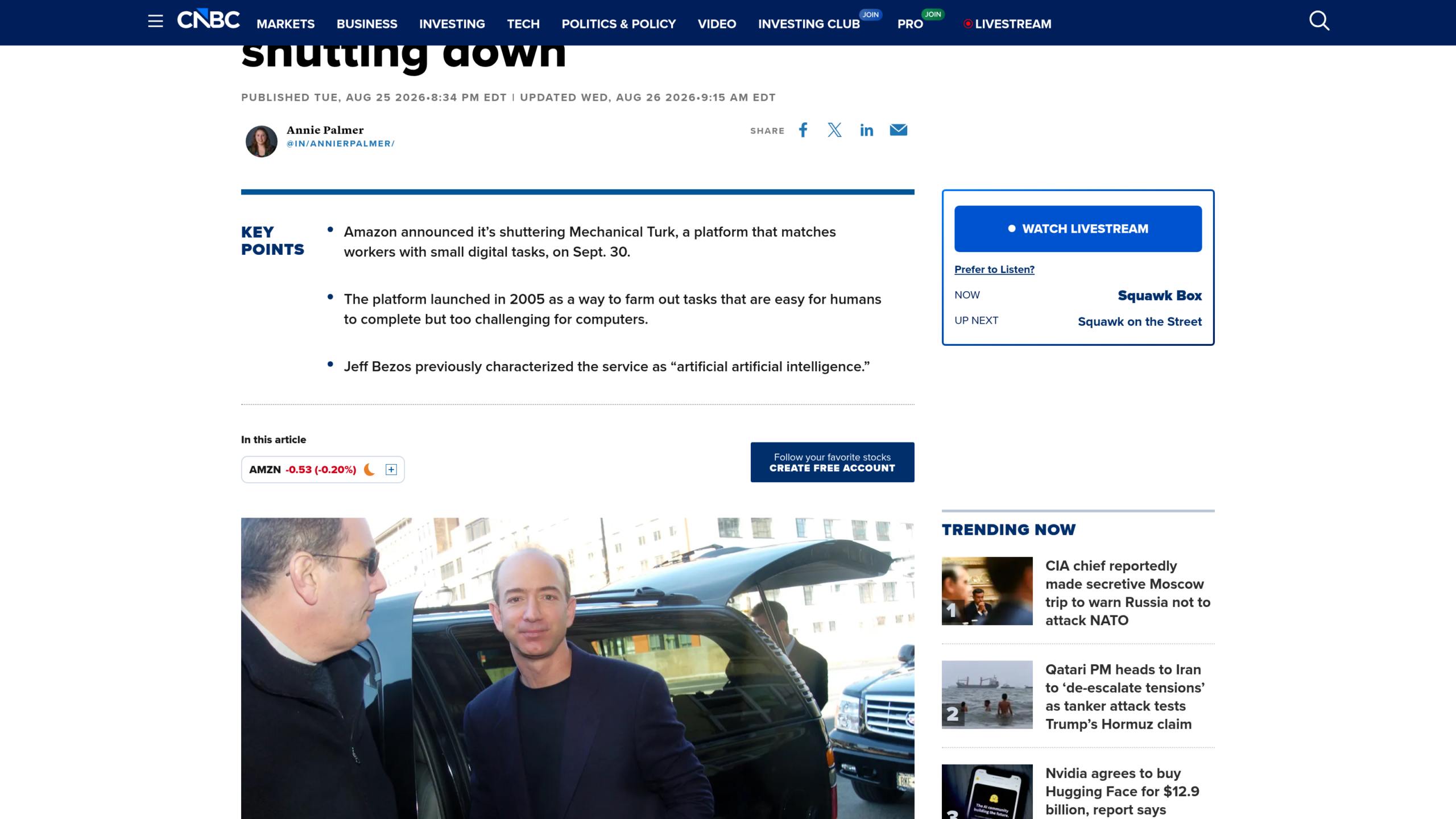
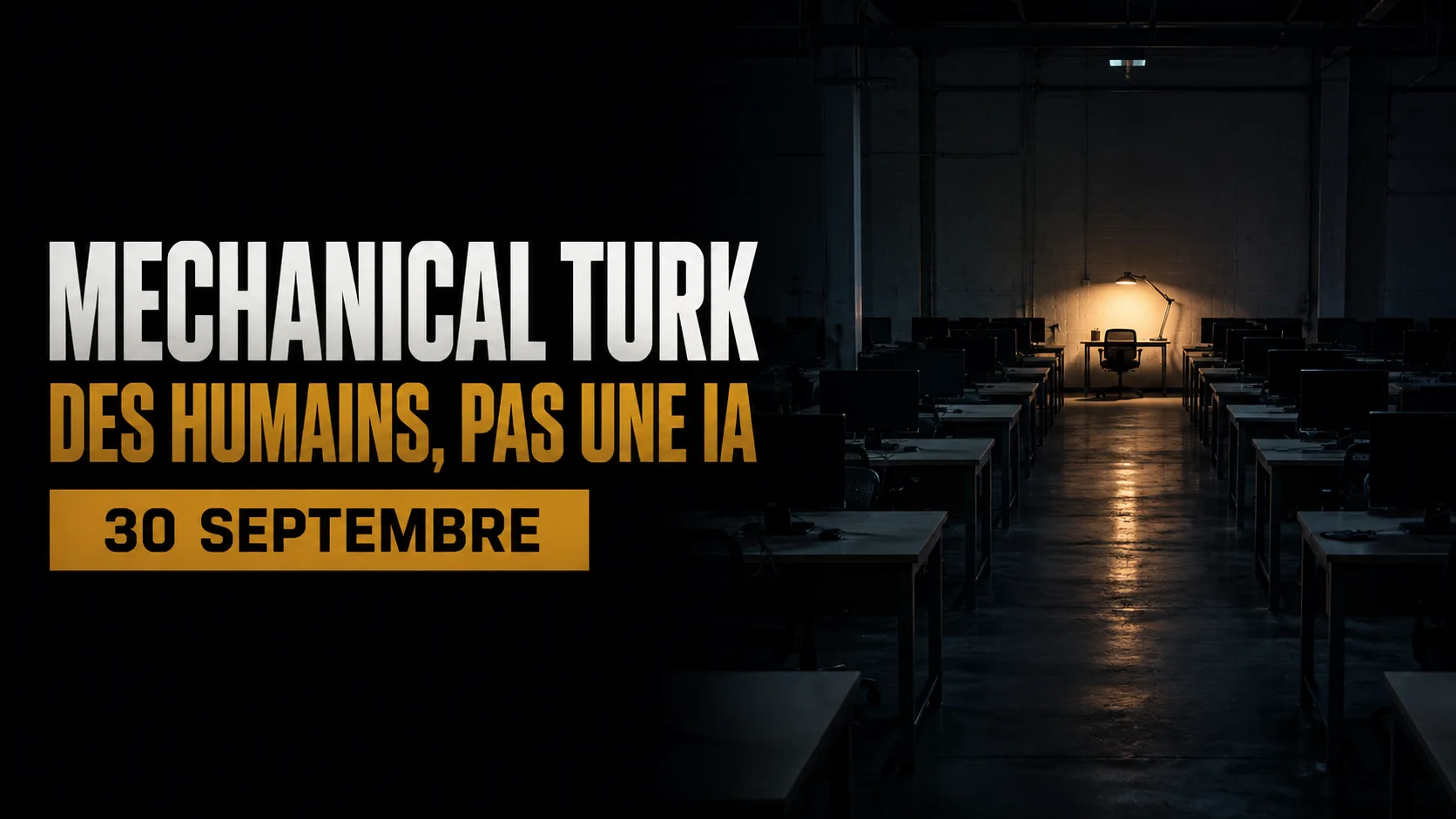
According to CNBC, Amazon announced the service’s closure on August 25, 2026. It will shut down on September 30, 2026, after 21 years in existence. Amazon says the decision followed an internal review of its programs and services. The same day, two other tools are closing: SageMaker Ground Truth (a tool for collecting annotated data to train AI models) and Amazon Augmented AI, both dedicated to gathering human judgments on raw data. Amazon is thus exiting the human-annotated data market entirely.
In 2005, AI Meant People Paid a Few Cents
Mechanical Turk worked on a simple principle. A company needed thousands of micro-tasks done fast and cheap: sorting images, verifying an address, transcribing an audio recording, judging whether a sentence made sense. It posted these « Human Intelligence Tasks » (work considered too subtle for a machine of that era, reserved for human judgment) on the platform: describing a photo’s content in one sentence, comparing two translations, saying whether a forum comment was abusive. Anyone could accept them and get paid, sometimes just a few cents per task.
At its peak, more than 500,000 workers passed through the platform. For many, it was extra income earned between other commitments, in the evening or on weekends, one task at a time. For client companies, it was a pool of cheap labor available around the clock, able to do in a few hours what a 2005 algorithm still could not do on its own.
This human labor became the foundation for an entire generation of artificial intelligence. Image recognition, voice transcription, and language processing models were trained on millions of hand-labeled examples, often produced by these same workers. Task after task, they built the data that let modern AI learn to do what they themselves had been doing, on an assembly line, for a few cents.
In 2023, 46% of Them Were Already Using AI
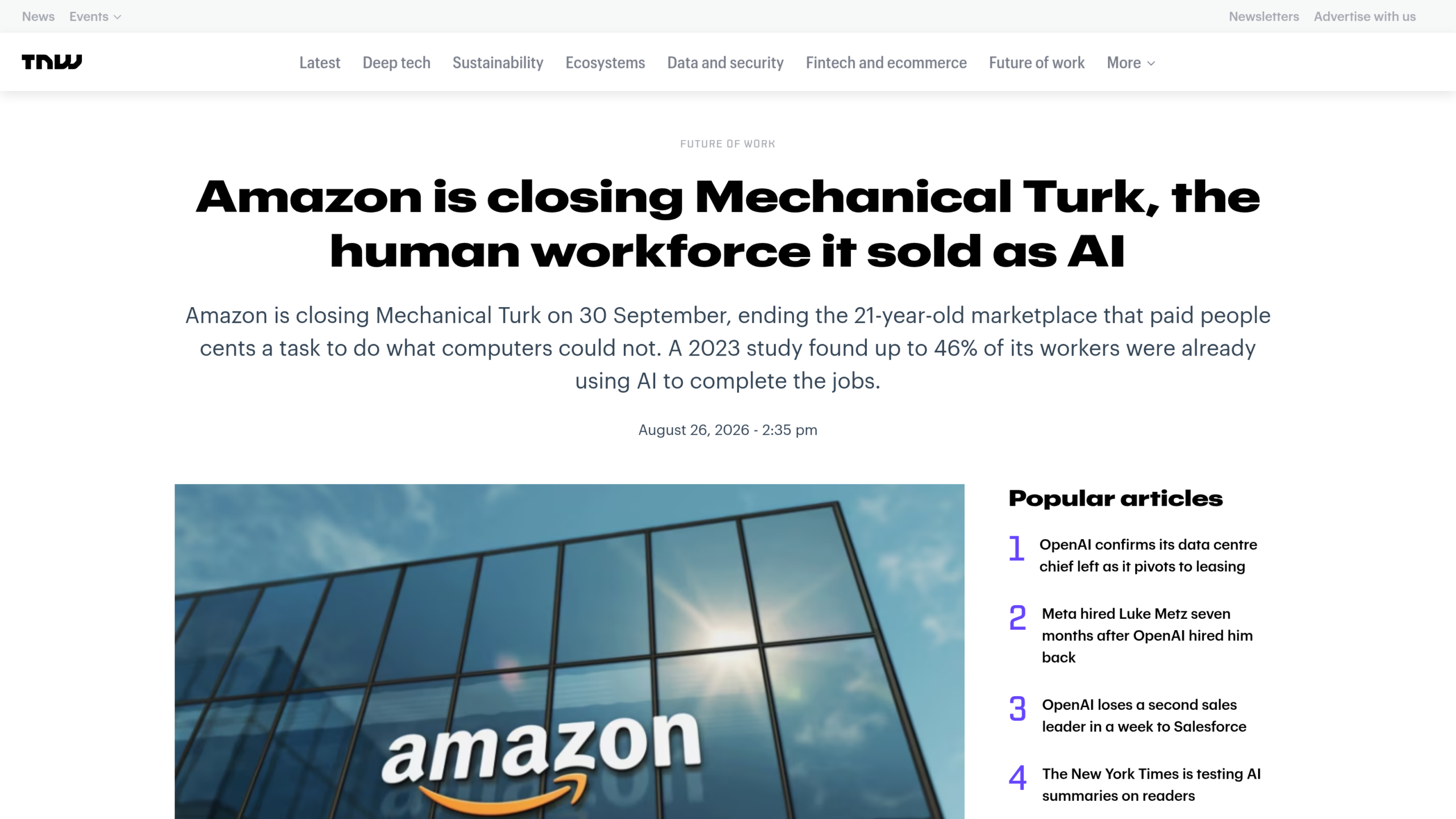
According to The Next Web, a 2023 study found that up to 46% of Mechanical Turk workers were already using AI tools to complete the tasks they were being paid to do themselves. Humans recruited to provide human judgment were outsourcing part of that judgment to chatbots, to work faster and handle more tasks per hour.
The loop closed even before the shutdown was announced. A platform marketed as artificial intelligence ended up employing real people who, to keep up the pace, relied on real AI. Neither the client who ordered the task, nor Amazon, could guarantee that a human was still hiding behind every answer. Long before a sector like music started asking whether to disclose what AI had made, Mechanical Turk was already living with that same confusion, quietly, without ever having to spell it out.
The service’s decline did not happen overnight, then. Amazon had been investing less and less in it for years, while newer competitors drew workers and client companies toward better-paying offers, built for the needs of generative AI rather than for the web of 2005.
What Is Replacing Mechanical Turk
The shutdown happened in two stages. According to TechCrunch, Amazon first announced, on July 5, 2026, that it would stop accepting new customers on Mechanical Turk starting July 30. Seven weeks later, the August 25 announcement set the final date: no more tasks, no more payments after September 30.
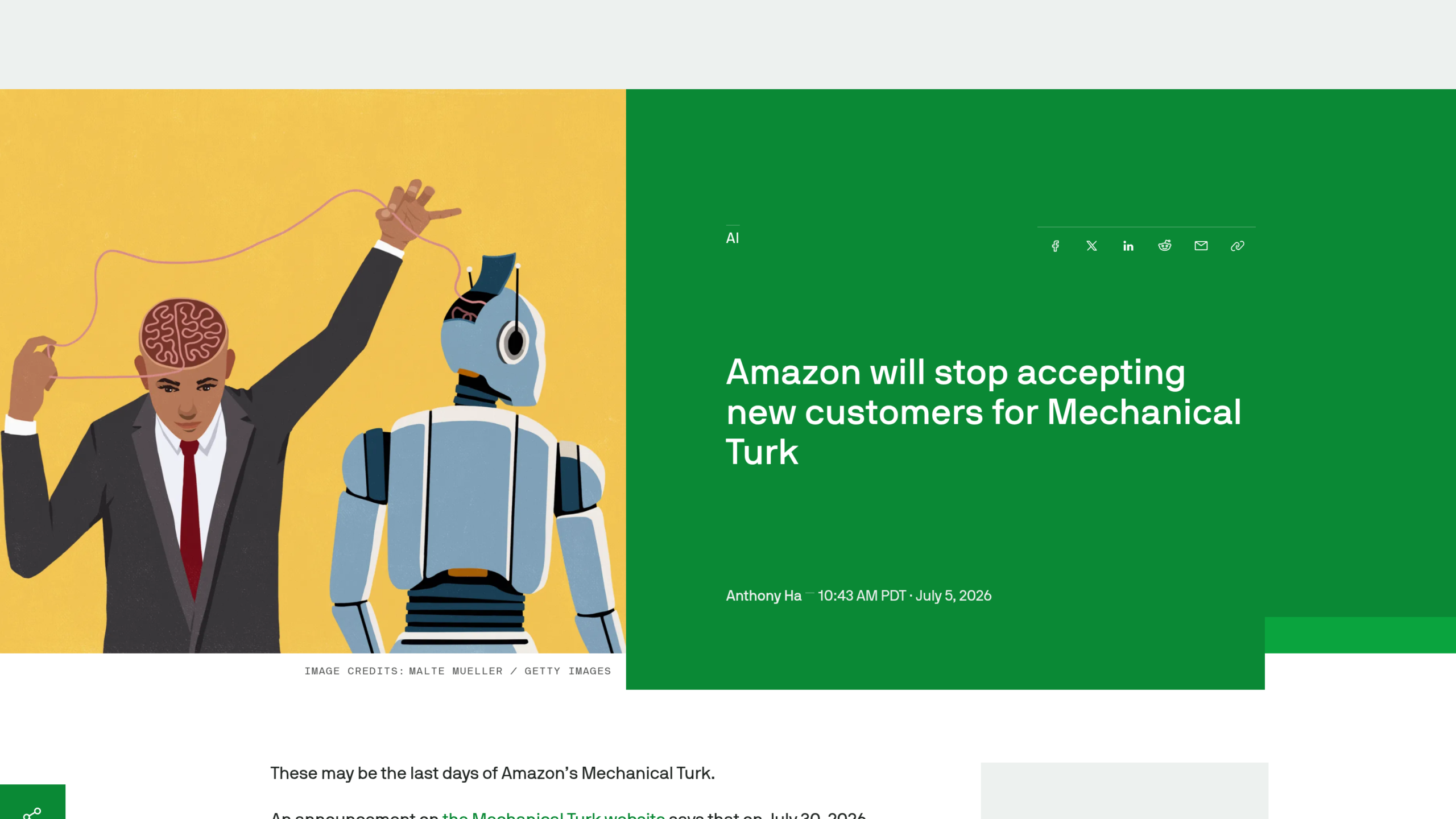
Amazon is closing Mechanical Turk while it keeps cutting costs on other fronts, and while it looks elsewhere for the training data the platform used to supply, including on Twitch, which Amazon owns. Human data collection has not vanished from the market. It has changed hands. Scale AI, Mercor, and Prolific have spent the past several years drawing in client companies and workers, with business models built for generative AI rather than for the few-cents micro-tasks of 2005.
The 18th-century Mechanical Turk was eventually exposed: a fire destroyed the automaton in 1854, and the secret of the chess player hidden inside was made public a few years later. Mechanical Turk the platform will not need a fire to reveal what it was hiding. It closes on September 30, 2026, twenty-one years after lending its name to the human labor that AI eventually took over. Its successors, for their part, no longer need to pretend the machine is working alone.









0 Commentaires
Aucun commentaire pour le moment. Soyez le premier à commenter !