
On August 20, 2026, Google activated a button that publishers can place on their site to join a reader’s list of Preferred Sources in Search, in Discover (Google’s personalized news feed), and in Google News (Google’s news aggregator). Clicking it tells Google: favor this site in my results. Google backs the idea with a number: a source ranked among the Preferred Sources gets twice as many clicks as an anonymous source.
The concept isn’t new. Google had rolled out Preferred Sources back in May 2026, but only inside its AI-assisted search experiences: AI Mode (the conversational search mode) and AI Overviews (the AI-generated summaries at the top of results). On August 20, the button left those pages and moved into classic search, Discover, and Google News.
The timing makes sense. Since the redesign unveiled at Google I/O 2026, search works as an answer engine, a system that gives the answer instead of pointing to a site: the user gets what they’re looking for without ever leaving the results page. The industry calls this zero-click search. Publishers have been paying the price for months. Google hands them a button.
How the Preferred Sources Button Works
TechCrunch published Google’s official screenshots on August 20: an « Add as a Preferred Source » button placed on mobile, available to the reader right on the publisher’s own page. Nothing is automatic. The site has to add the button, the visitor has to see it, and then click.
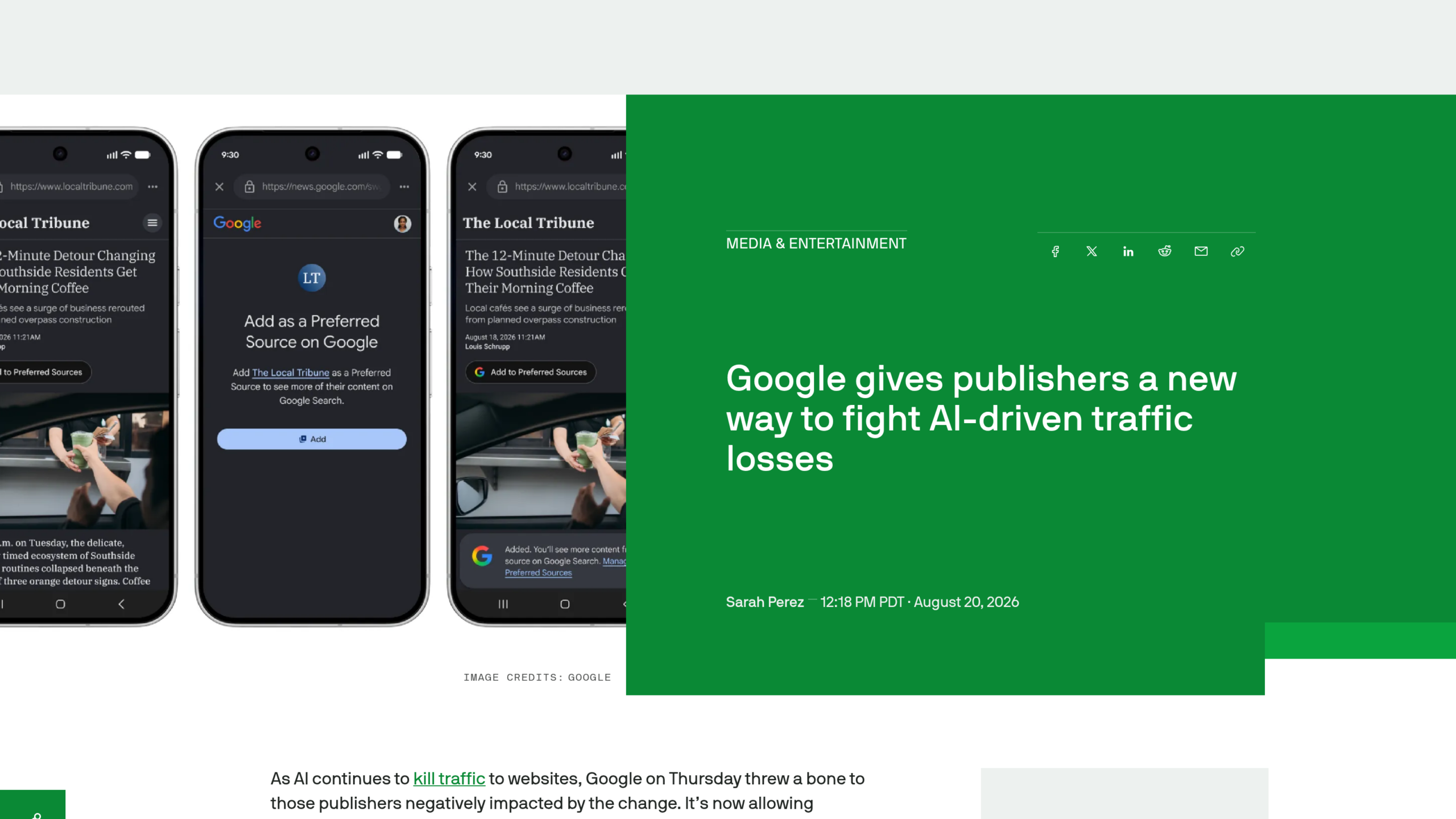
Once the click is made, the site joins the Preferred Sources list tied to that Google account, not to every user of the engine. The ranking changes for that specific reader, in their searches, in their Discover feed, in their Google News tab. Another user who never clicked sees nothing change.
This same logic of individual action shows up elsewhere. When DeepSeek changed strategy with V4 Pro, it fell to developers to migrate, not to the provider to carry the transition.
The Collapse That Came Before the Button
Google’s gesture answers a measured hemorrhage. There is no public, agreed-upon measurement of how many searches end without a single site being visited, but every industry estimate puts that share sharply on the rise. The verifiable figures are more modest, and they track the traffic actually passed on.
Chartbeat put a number on referral, the traffic a search engine sends to publishers: down 34% over one year for traffic coming from Google Search. Over two years, the gap widens depending on the size of the publisher.
| Publisher size | Loss of search referral traffic (2 years) |
|---|---|
| Small publishers | 60% |
| Mid-size publishers | 47% |
| Large publishers | 22% |
The Next Web summed up the situation on May 21 in a headline that hasn’t aged a day: the AI search redesign serves Google, and it fails everyone who makes the web worth searching.
Money, meanwhile, keeps flowing elsewhere in the artificial intelligence sector. Stripe recently acquired OpenRouter for 7 billion dollars, a sum that shows the scale of capital being poured into artificial intelligence while publishers count their traffic losses.
Preferred Sources, a Two-Speed Remedy
The button doesn’t fix anything on its own. It shifts the burden: it’s no longer Google correcting its engine, it’s the reader who has to take an extra step to keep a site visible. That reader still has to exist in the first place.
A publisher that keeps a loyal audience has visitors ready to click its Preferred Sources button. A small site that lost 60% of its referral traffic in two years no longer has the audience to make that gesture for it. The system protects, first and foremost, those who need it least.
kami-labs.fr falls into the small-publisher category these numbers describe, here just like anywhere else on the independent web. The question comes down to the same terms as elsewhere: a Preferred Sources button is only as good as the audience still around to see it.
Other cases show that a balance of power can also flip. Beijing recently forced the cancellation of an acquisition that had already closed, forcing Meta to give up Manus. Nothing of the sort is on the table between Google and news publishers, but the example is a reminder that a dominant player doesn’t always get the last word.
What the Button Changes for a Reader
The Preferred Sources button appears on the publisher’s site, not on Google. A reader has to find it on the page, click « Add as a Preferred Source, » and the gesture only counts for the Google account used at that moment.
What the button does: it pushes the site higher in that specific reader’s results, in Search, in Discover, in Google News. What it doesn’t do: it doesn’t lower the share of zero-click searches, it doesn’t restore any referral traffic lost from visitors who never clicked, and it changes nothing about the answers AI Overviews already gave before the reader ever saw a single button.
Another recent move sheds light on the same logic, in reverse. Twitch turned on Amazon’s AI training on streams by default for its creators, leaving it up to each of them to opt out if they want to. Google flips the mechanic: nothing happens without an active click from the reader. In both cases though, it’s the user who has to make the move the platform could have made itself.









0 Commentaires
Aucun commentaire pour le moment. Soyez le premier à commenter !