
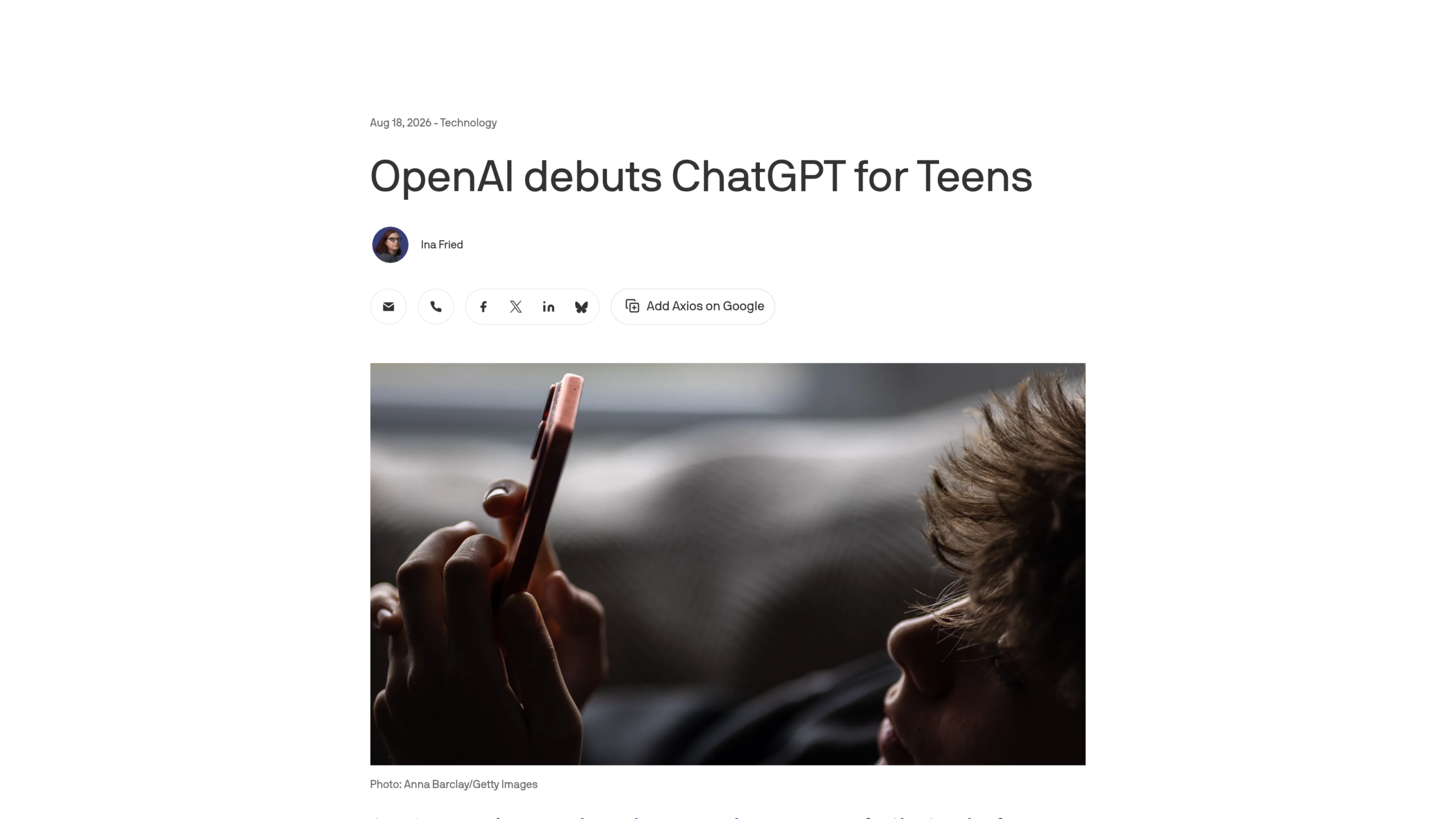
OpenAI launched ChatGPT for Teens on August 18, 2026. The rollout spans about two weeks, worldwide. The target: 13 to 17 year olds. An account automatically switches to this version as soon as the system estimates its holder is under 18, or as soon as the user declares their own age between 13 and 17.
The principle sounds simple on paper. OpenAI promises, with ChatGPT for Teens, stronger protections on sensitive topics, a mode built for learning rather than for copying ready-made answers, and new settings for parents. None of this relies on an ID document. The whole system therefore rests entirely on OpenAI’s ability to guess who is on the other side.
This launch is part of a broader set of measures: parental controls already in place, a model specification (the document that describes how the AI must behave) dedicated to users under 18, a plan called Teen Safety Blueprint, and an age-prediction system (an automatic estimate, with no official document required) rolled out earlier this year. TechCrunch summed up the timeline in one line: « OpenAI launches a safer ChatGPT for teens, years after teens started using it. »
ChatGPT for Teens: the automatic account switch
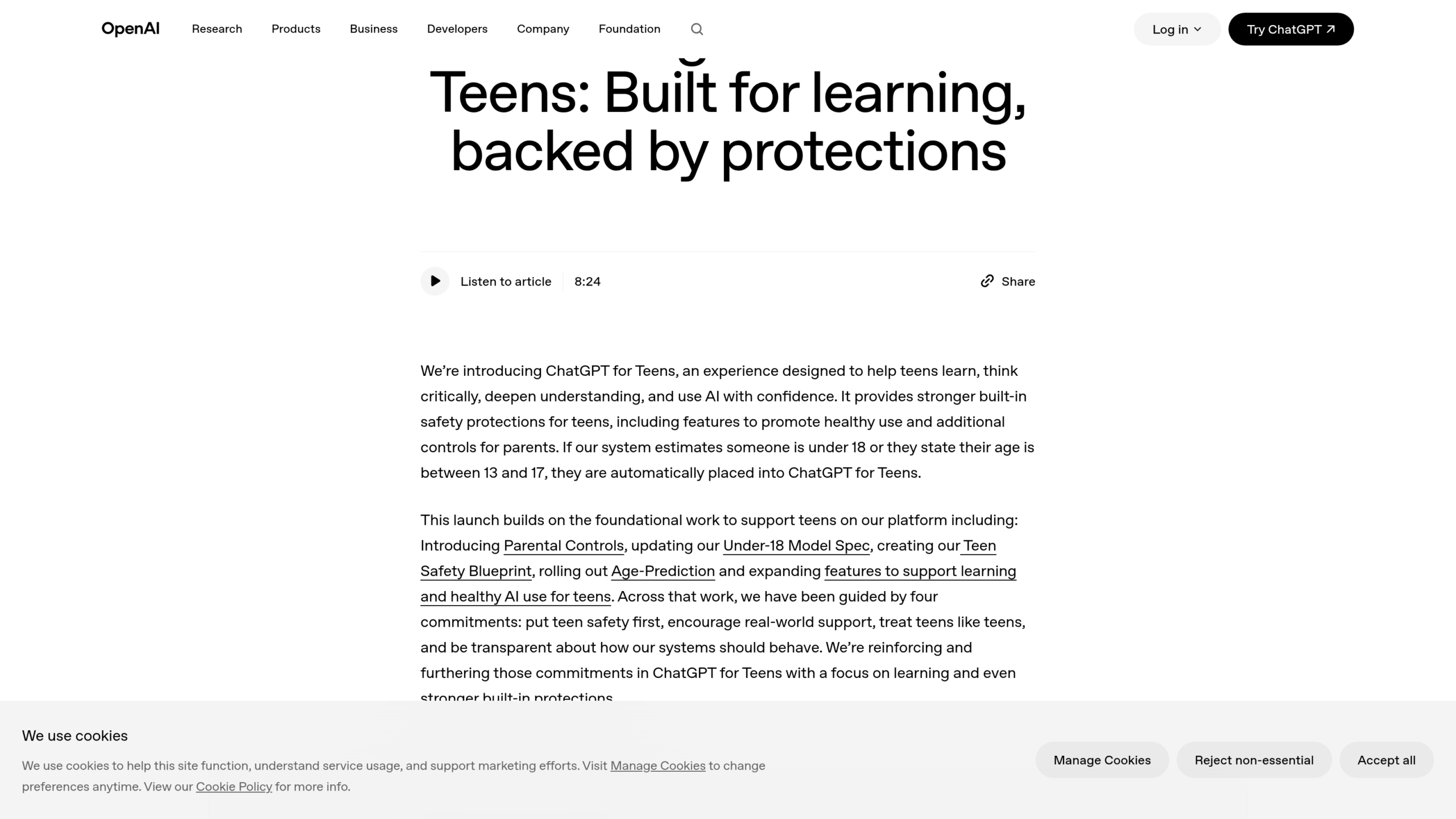
Switching to ChatGPT for Teens requires no special action. An existing account whose information suggests a minor age switches on its own. A new user who declares being between 13 and 17 is placed directly into this experience. OpenAI explains this in its official announcement: « If our system estimates someone is under 18 or they state their age is between 13 and 17, they are automatically placed into ChatGPT for Teens. »
Age-appropriate protections are active by default on ChatGPT for Teens, with no setting to turn on. This choice echoes a broader trend among platforms that weigh heavily on teenagers’ lives. Twitch also chose a controversial default setting, training Amazon’s AI with creators’ streams without prior consent. A setting decided in advance, that the user has to find in order to change it.
These protections cover four precise areas: self-harm, suicide, romantic content, and sexual content. On these topics, the chatbot’s replies change in tone and content compared with the adult version. OpenAI does not detail every technical adjustment, but confirms they are systematically activated as soon as an account switches to teen mode.
Age prediction, without ID documents
No formal identity verification is required to open or keep a ChatGPT for Teens account. Placement relies on three signals: the information already tied to the account, the age declared by the user, and OpenAI’s age-prediction system. The latter estimates the likely age from behavior and conversations, without ever asking for an ID card or passport.
OpenAI openly accepts this trade-off. Verifying every teenager’s identity would mean collecting ID documents from millions of minors, with the data-leak risks that entails. OpenAI chose an estimate instead, even if it can be bypassed. A teenager who declares being 25 at sign-up leaves the protective system within seconds.
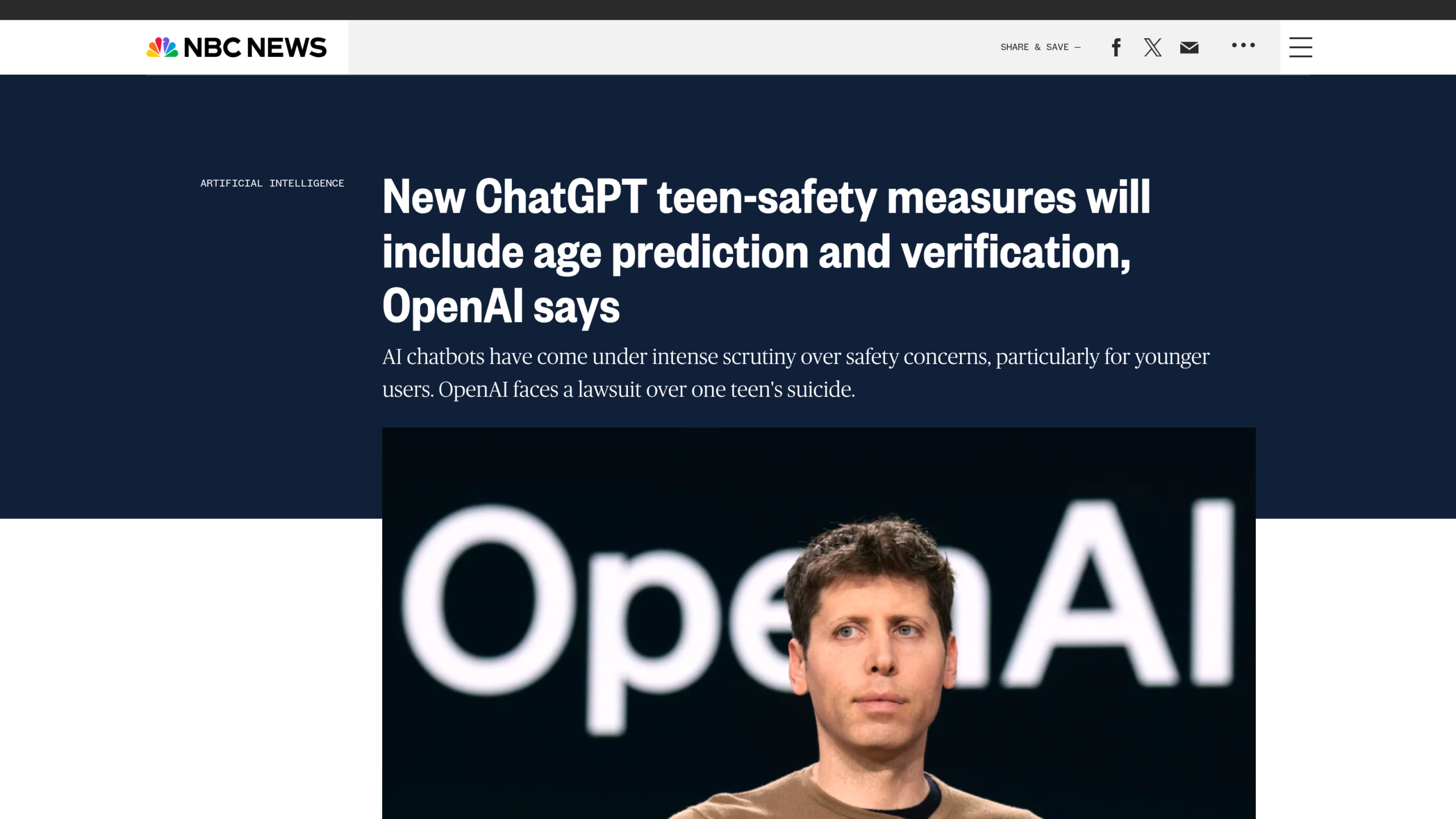
The American press picked up on this right from the announcement. NBC News headlined the addition of age prediction and verification among the new safety measures for teens. Axios covered the launch the same day, August 18, placing it within OpenAI’s series of responses to pressure over minors’ safety. This pressure also comes from the regulatory front: in Europe, Anthropic agreed to watermark text produced by Claude under pressure from the AI Act.
Timing matters here. OpenAI faces several lawsuits over the lack of safeguards on its chatbots, including one tied to a teenager’s suicide. These protections for teens arrive after these legal proceedings, not before them. TechCrunch put it bluntly in its headline. The timeline alone sums up the balance of power between AI makers and regulators: in Washington, political pressure recently forced Anthropic to shut down one of its models, Claude Fable 5, in the United States.
A Study Mode instead of a ready-made answer
On the learning side, ChatGPT for Teens relies on a Study Mode, quizzes, visualizations, and homework reminders. The stated goal: steering toward understanding rather than copying an already written answer. A teenager who submits an equation does not immediately get the ready-made solution.
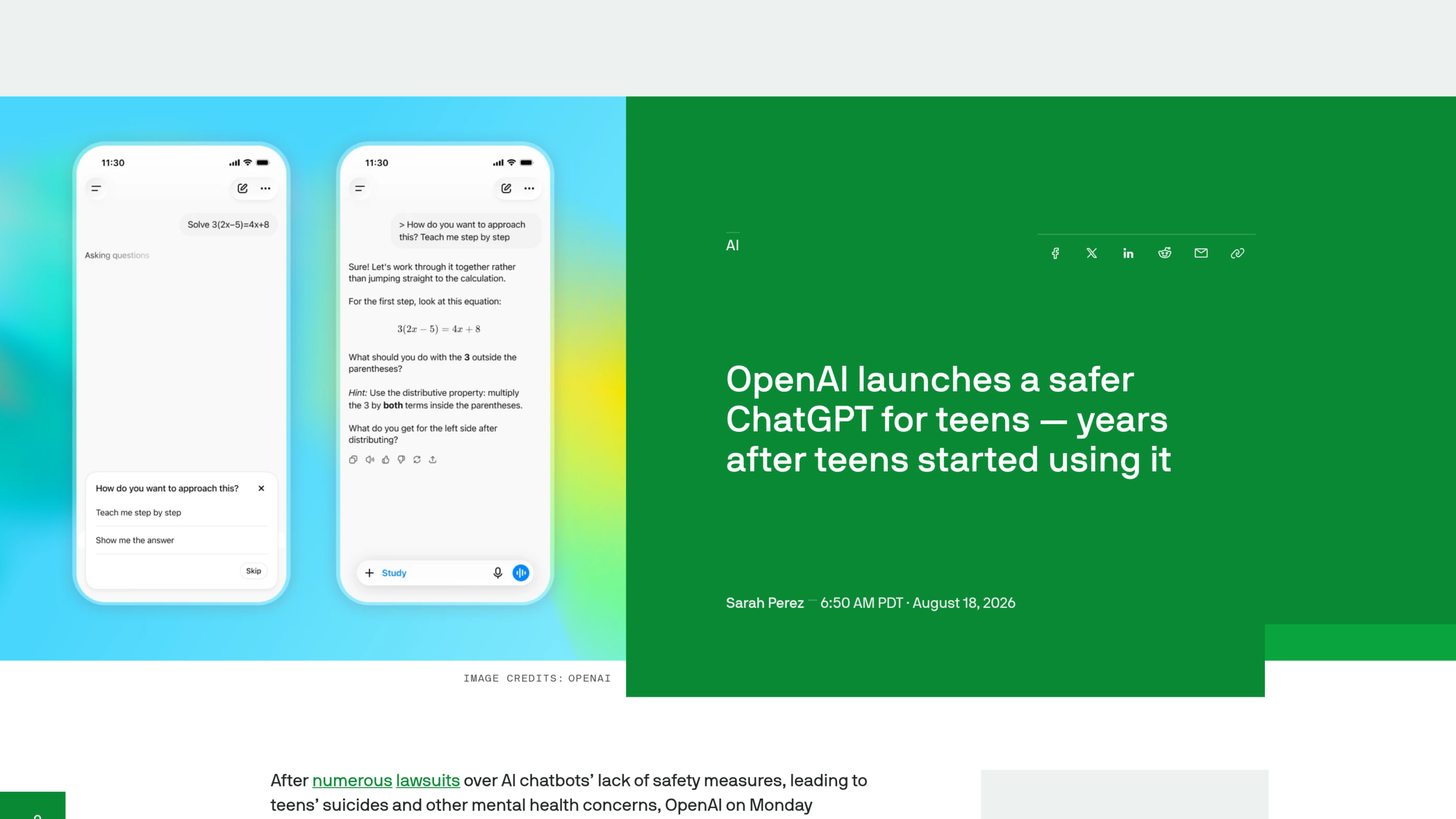
Two buttons appear in its place: “Teach me step by step” or “Show me the answer”. The first walks through the solving method, step by step. The second gives the result directly, no detour. TechCrunch published screenshots of this mode provided by OpenAI, showing the interface for choosing between the two options.
This approach is part of the Under-18 Model Spec, updated by OpenAI ahead of this launch. The document sets the behavior principles expected of the model when facing a minor user, beyond the school context alone. The same idea of a model tailored to a precise use case appears elsewhere at the company, where a variant of GPT 5.6 is used to spot cybersecurity flaws.
Parental controls: what a ChatGPT for Teens account allows
A parent can link their account to their child’s. Once the link is set, they gain access to certain settings and receive safety notifications if a concerning signal comes up. They can also set Quiet Hours, time windows during which access is reduced or shut off entirely.
One limit is stated in black and white: parents cannot read their teenager’s conversations. The control covers the framework, the hours, the alerts, never the content exchanged.
OpenAI says it relied on four commitments to build ChatGPT for Teens: putting safety first, encouraging real human support rather than relying on the AI alone, treating teenagers as teenagers rather than small adults, and staying transparent about the system’s expected behavior. The Teen Safety Blueprint, published earlier in the year, had already laid out this framework before the product itself arrived.









0 Commentaires
Aucun commentaire pour le moment. Soyez le premier à commenter !