

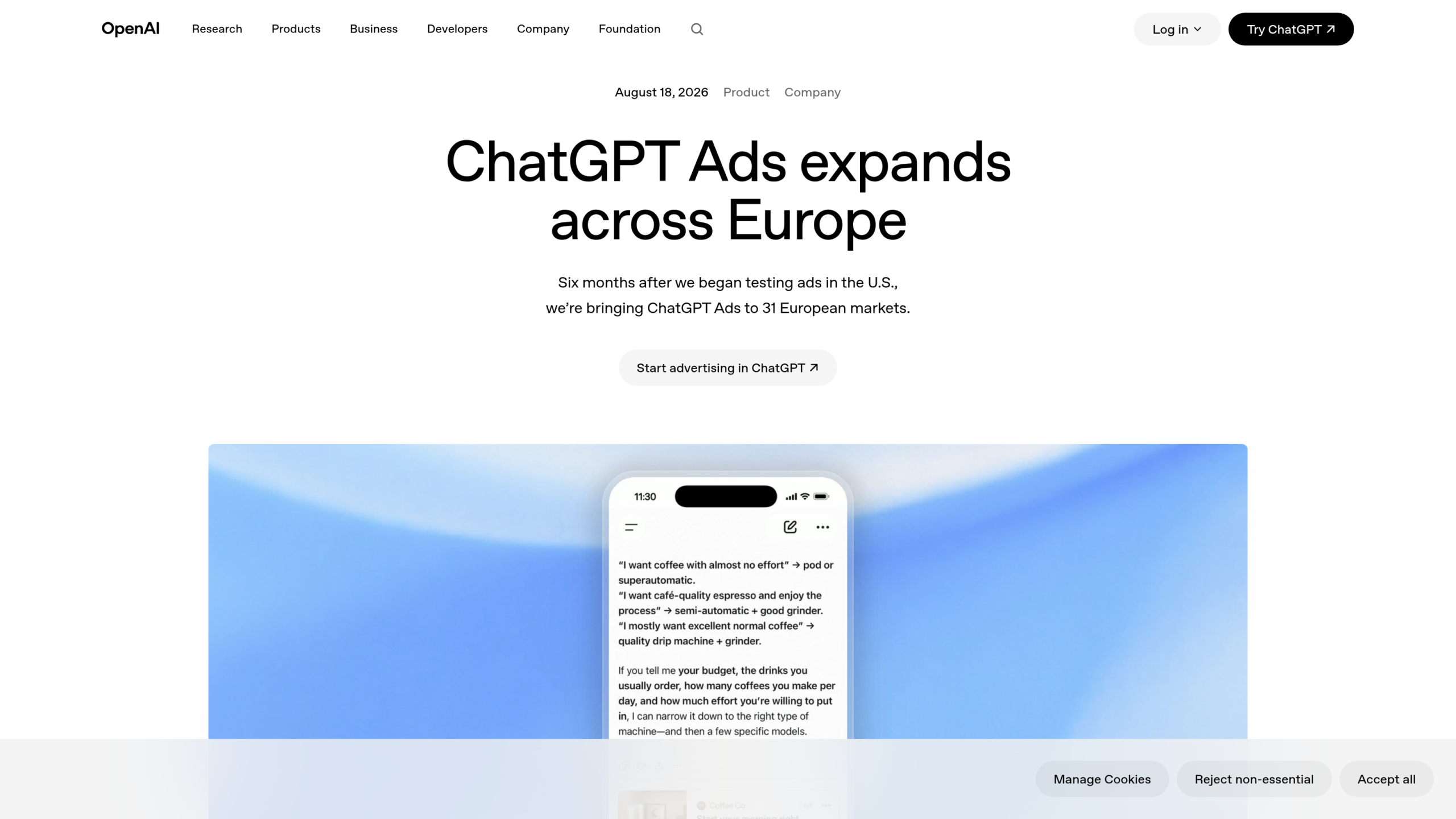
OpenAI announced on August 18, 2026 that ChatGPT ads are coming to 31 European markets, including France. The rollout begins on Monday, August 24, 2026, six months after testing started in the United States. In its announcement titled “ChatGPT Ads expands across Europe,” the company sums up the scale of the move: “Six months after we began testing ads in the U.S., we’re bringing ChatGPT Ads to 31 European markets.”
This European expansion is, in OpenAI’s own words, its largest to date: “The addition of 31 European markets marks our largest expansion to date.” Countries named by the press include Germany, Spain, Italy, Sweden, Norway, Denmark, Austria, and the Netherlands, in addition to France. OpenAI has not published the full list of the 31 markets in its announcement.
For a ChatGPT user in Europe, the practical question comes down to a few points: who sees these ChatGPT ads, what they look like, what they know about the ongoing conversation, and how to limit them. The answers are spelled out in OpenAI’s official announcement and in its help center.
Who Will See ChatGPT Ads, and on Which Plan
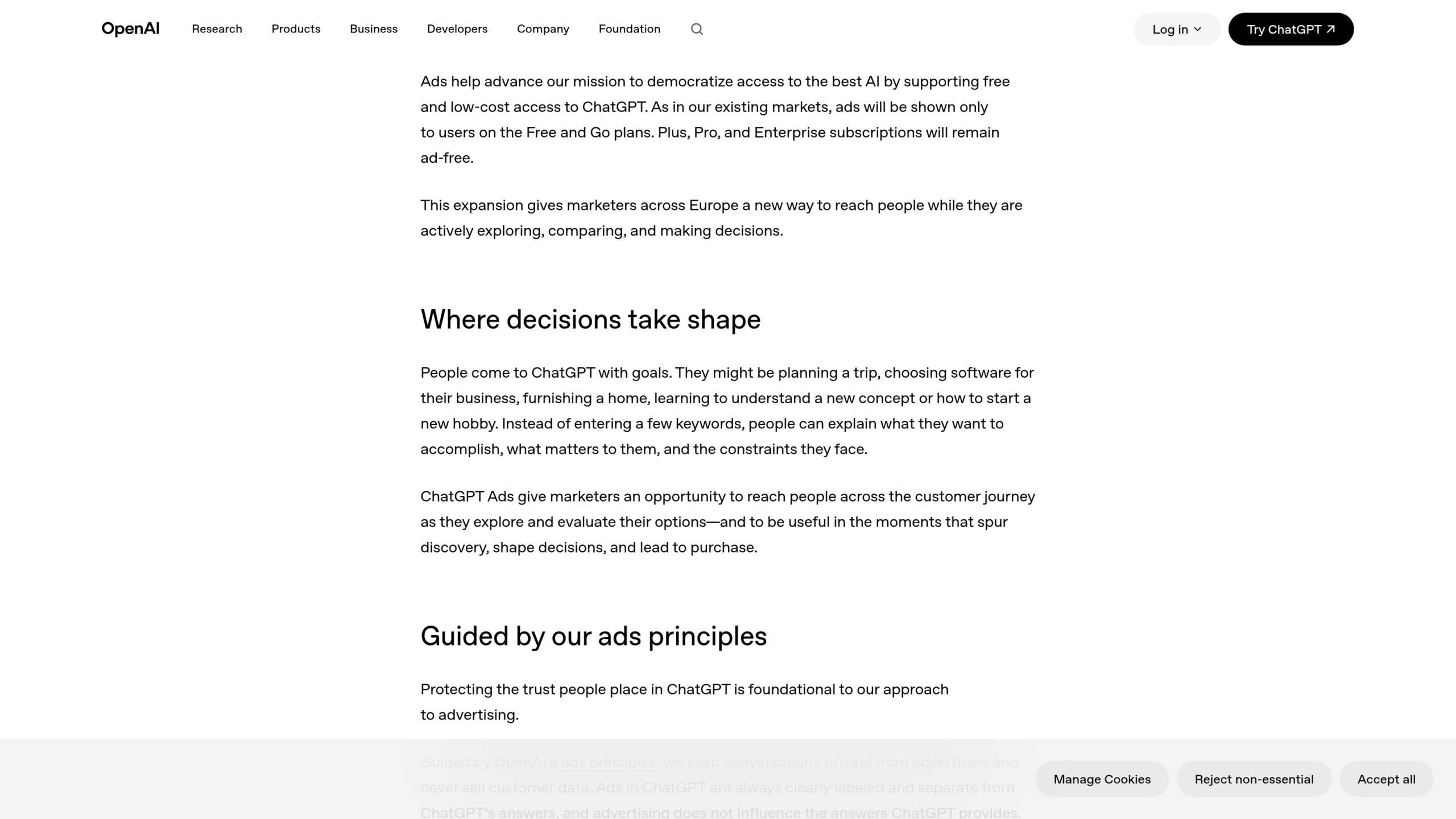
ChatGPT ads do not apply to every subscription. OpenAI states this without ambiguity: “ads will be shown only to users on the Free and Go plans. Plus, Pro, and Enterprise subscriptions will remain ad-free.” In other words, only the Free and Go plans show ads; the paid Plus, Pro, and Enterprise plans remain exempt.
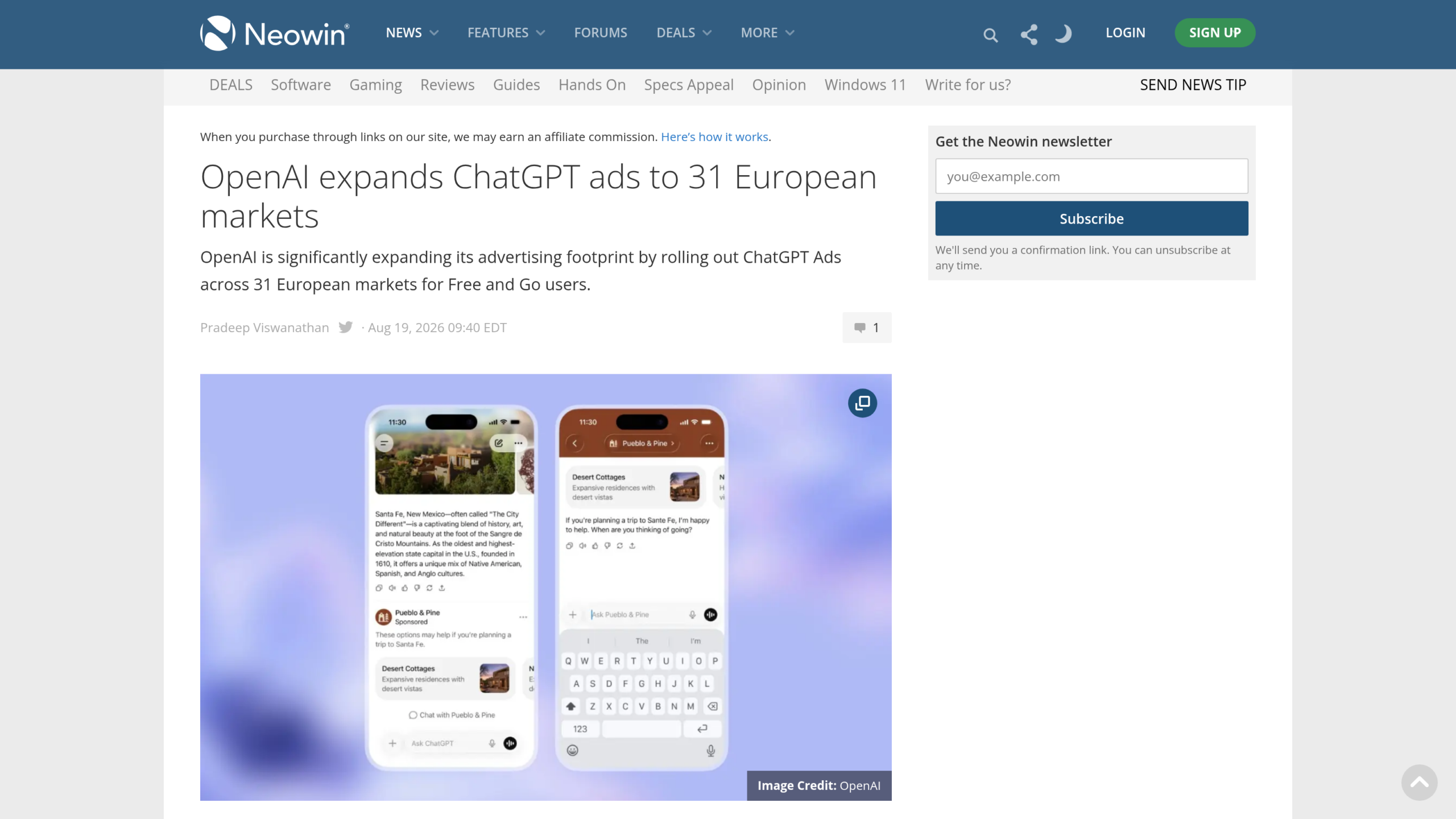
The format OpenAI chose places the ad unit below the response generated by ChatGPT, in a visually distinct block marked as sponsored. Neowin, which covered the announcement on August 19, 2026 in a piece by Pradeep Viswanathan, illustrates this format with an official visual showing the ad inserted after a response, separated from ChatGPT’s text by a clean frame.
| ChatGPT Plan | ChatGPT Ads Shown |
|---|---|
| Free | Yes |
| Go | Yes |
| Plus | No |
| Pro | No |
| Enterprise | No |
A Rollout That Begins August 24 in 31 Countries
The timeline comes down to two dates. The announcement was published on August 18, 2026, and the actual rollout begins on Monday, August 24 in the 31 targeted markets. Less than a week separates the two dates: affected users had no time to prepare, and nothing appeared in the app to warn them.
This European launch did not come out of nowhere. OpenAI launched its advertising pilot in the United States in February 2026, then expanded it to eight additional markets over six months. The company says tens of thousands of advertisers had already run ChatGPT ads even before this European expansion.
Contextual Targeting, Not Personalized, at Launch
The point that matters most for a privacy-conscious reader is targeting. At launch in the European Economic Area (EEA, which covers the European Union plus Iceland, Liechtenstein, and Norway) and in Switzerland, ChatGPT ads are purely contextual. That means they rely on the topic of the ongoing conversation, an approximate location, the type of device used, the time, and the language.
The stated exclusions are specific. Contextual targeting for ChatGPT ads draws on none of the following: past conversations, ChatGPT’s memory, an advertising history, or data supplied by advertisers. The company sums up its position this way: “we keep conversations private from advertisers and never sell customer data. Ads in ChatGPT are always clearly labeled and separate from ChatGPT’s answers, and advertising does not influence the answers ChatGPT provides.”
Personalization Will Wait for Explicit Consent
A more advanced version already exists on the product side: personalization, which would rely on advertising history, inferred interests, and data cross-referenced between sessions. It is not available at launch in the EEA and in Switzerland, and OpenAI expects it will require explicit, separate consent from each user.
Turning off this targeting does not make ChatGPT ads disappear from the interface. According to OpenAI’s help center and coverage from Digiday and TechTimes, ads remain visible but become purely contextual once targeting is turned off. The settings are found under Settings, in the “ad controls” section, where it is also possible to delete one’s advertising data. The same mechanism shows up elsewhere in artificial intelligence: Twitch, for example, has enabled default processing on its streams, which the user must opt out of themselves.
On the exact legal basis, sources disagree. Digiday cites consent as the basis for personalization, without detailing which basis applies to contextual targeting; other outlets point to legitimate interest, a concept from the GDPR (the European data protection regulation), to justify showing ads without prior consent. No source allows for a definitive answer on exactly which basis applies to which type of ad.
An Ad Platform Built Since February 2026
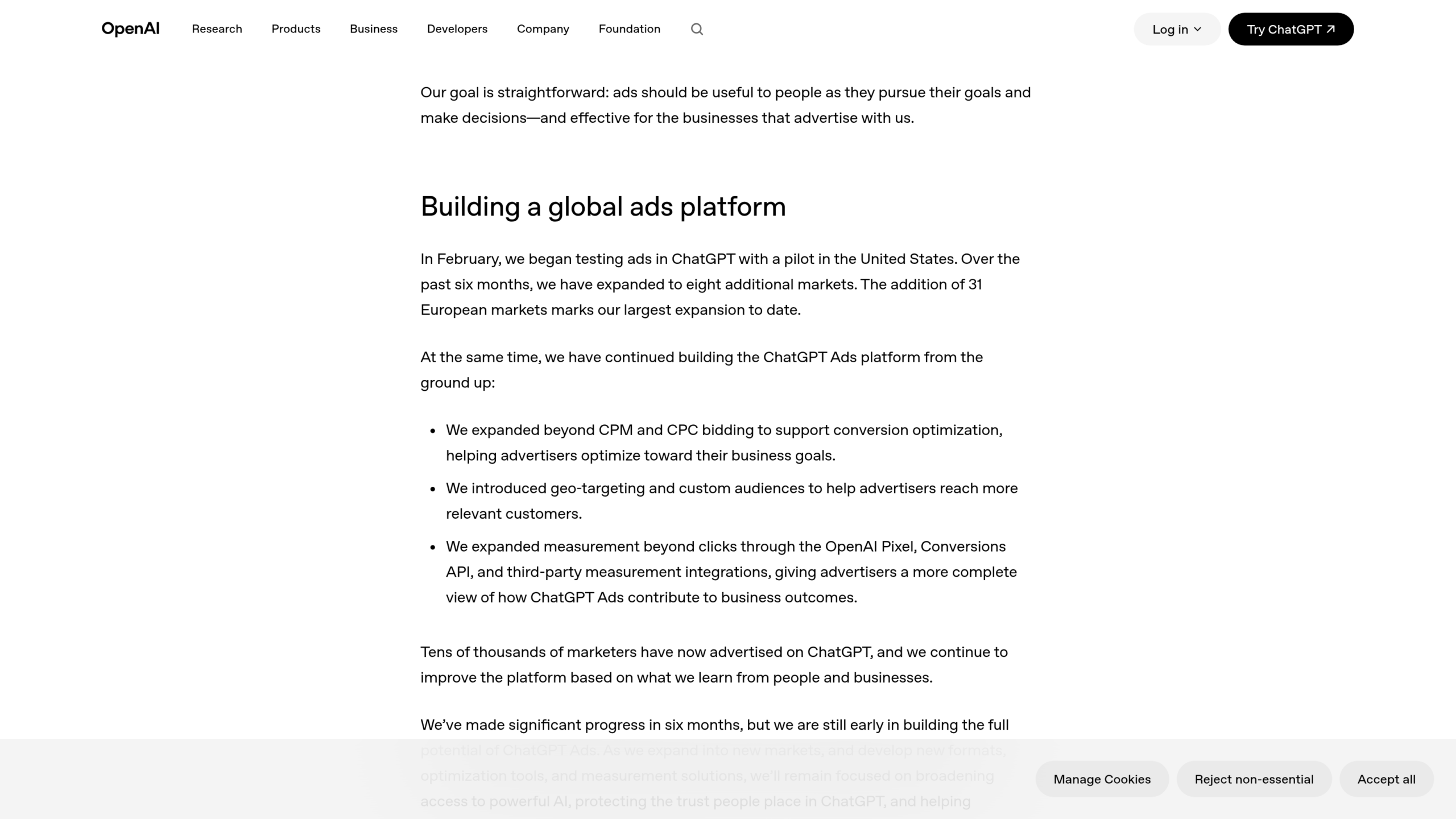
The expansion to 31 European markets builds on infrastructure that is already well established. OpenAI has built tools dedicated to ChatGPT ads, modeled on those of established ad platforms: CPM bidding (cost per thousand impressions) and CPC bidding (cost per click), conversion optimization, geographic targeting, custom audiences on the advertiser side, and measurement through a tool called “OpenAI Pixel” paired with a conversions API.
This buildup illustrates a question facing the entire industry: how to fund a free conversational assistant at scale. Google is exploring a similar path with Gemini, whose billion users raise the same business-model question. OpenAI has also made a series of adjustments aimed at Europe, such as the version dedicated to 13 to 17 year olds. And Europe, for its part, already regulates these tools with its own requirements, such as the watermark the AI Act imposes on Claude.









0 Commentaires
Aucun commentaire pour le moment. Soyez le premier à commenter !